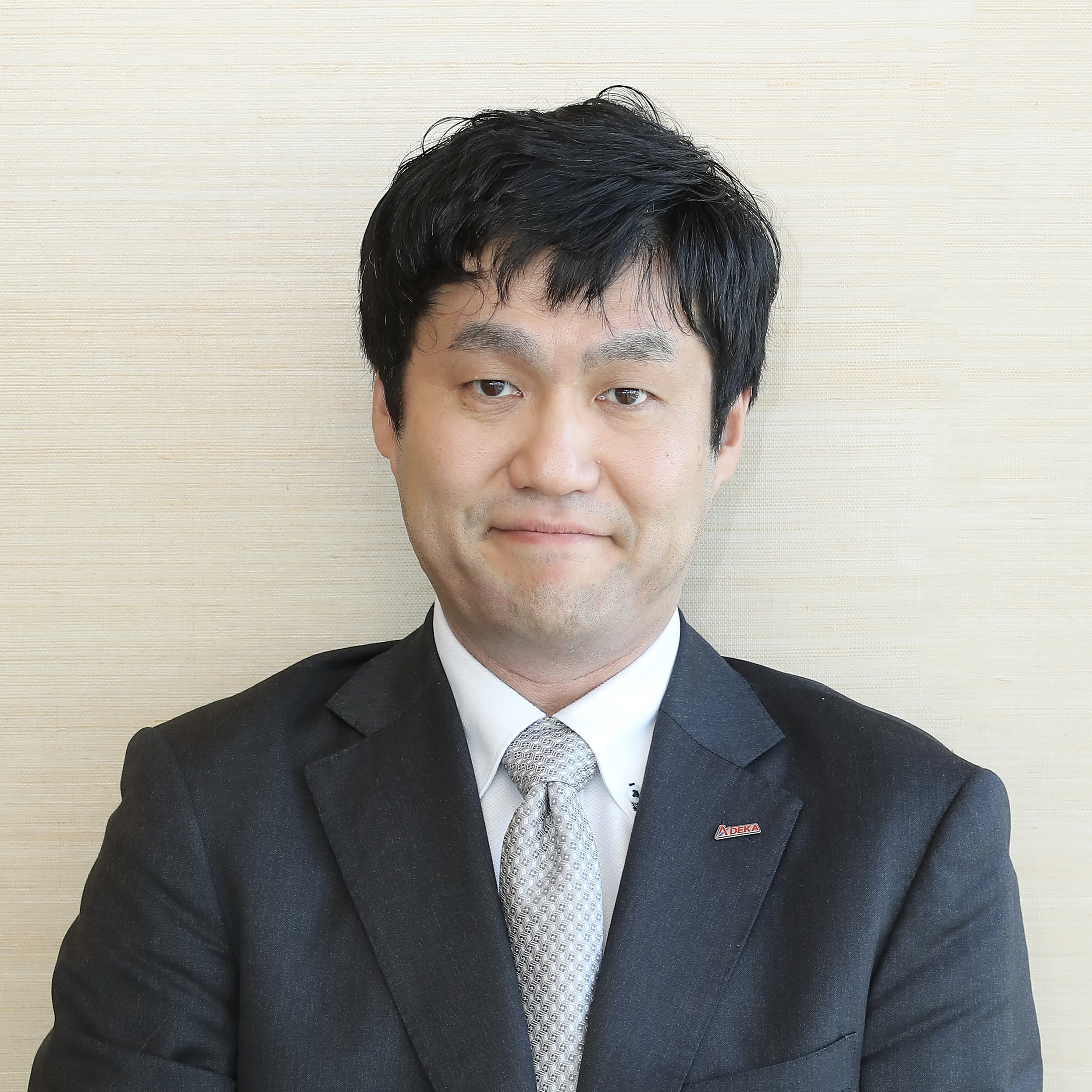
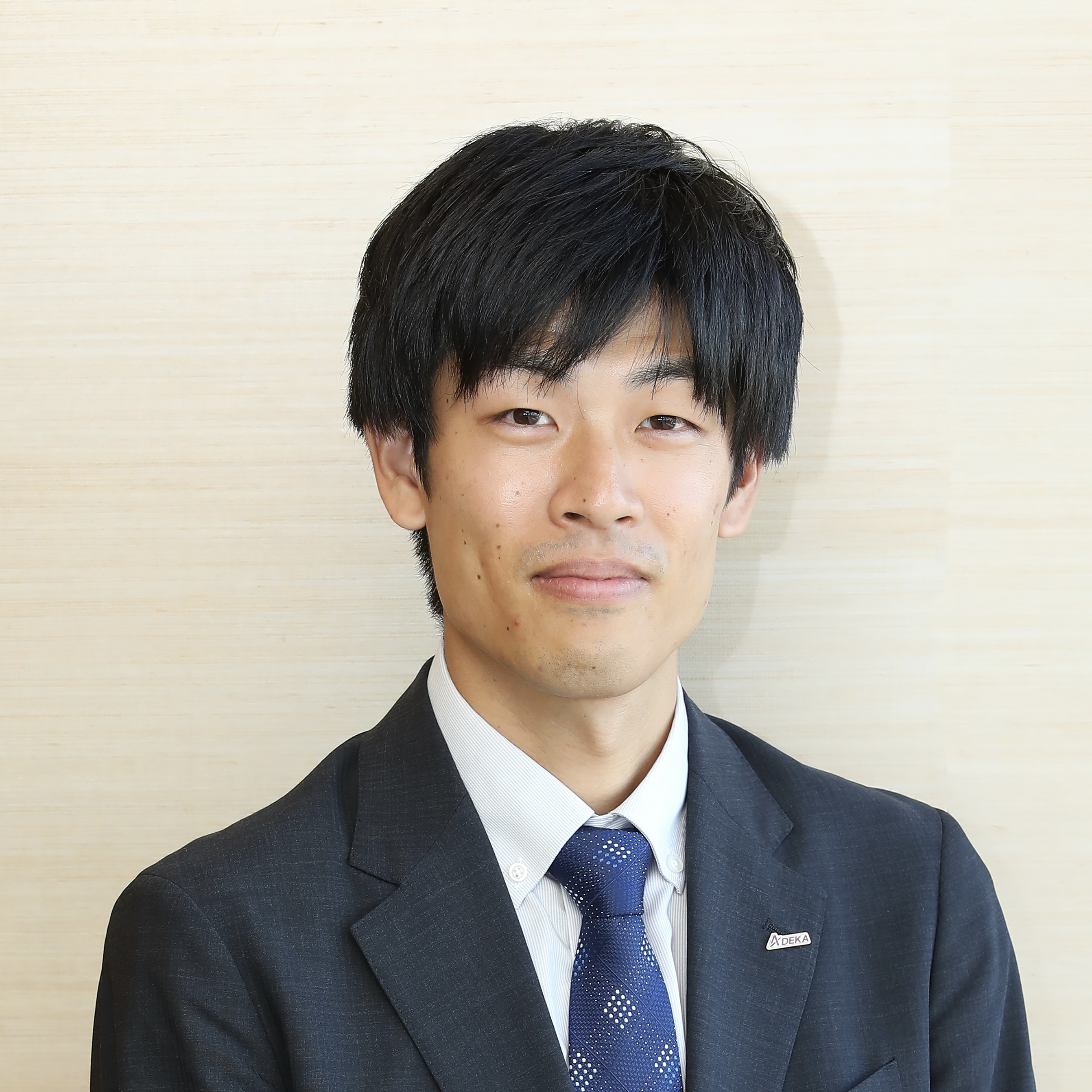
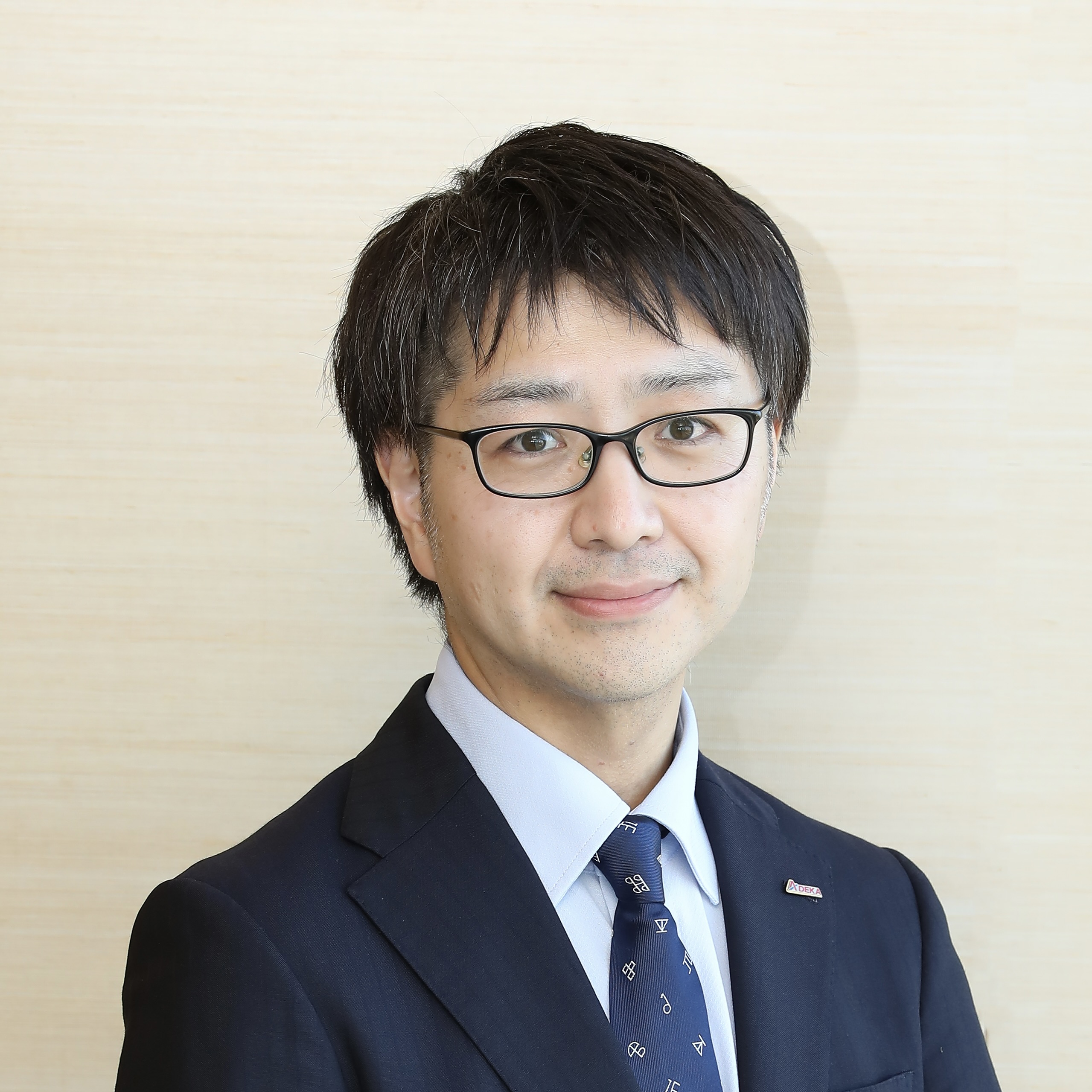
ADEKA CORPORATION operates globally across three core businesses: chemicals, food, and life sciences. Drawing on its own proprietary technologies, the company supplies competitive, high-performance products that support better lives worldwide and the development of a sustainable society. ADEKA's exploration of Materials Informatics (MI) began with a hands-on project run by MI-6, and in 2024 the company adopted miHub®. We spoke with Ken Matsumoto, General Manager of the R&D Planning Office, and with Kensuke Yokota and Shota Uno, who lead MI adoption inside the company, about how this came about and where it is heading.
Hitting a Data Management Wall: Quality That Lived in Individual Hands
To begin, could you tell us a little about ADEKA's businesses and your own department?
ADEKA started more than a hundred years ago with the domestic production of caustic soda, and we diversified from there by making use of the hydrogen and chlorine generated as by-products. Today we run three core businesses: chemicals, food, and life sciences.
Our strength comes from a principle written into our corporate philosophy: staying alert to new currents of change. Our response to those changes is shaped by our corporate slogan, "Add Goodness." We work to deliver, as quickly as possible, materials that add high performance to other products in small quantities, and we do that by taking a market-in approach and through close dialogue with our customers in our R&D.
The R&D Planning Department, where we work, is the planning arm of the headquarters function that oversees technology across the company. Our role is to link the technologies and strategic directions of every business division horizontally, and to deliver higher-value offerings through cross-divisional collaboration and the creation of new themes.
What prompted you to look at MI, and what were the challenges you saw at the time?
It all started when my predecessor was looking at data-driven approaches to speed up R&D, and ran a trial of MI-6's Hands-on MI® project. To be honest, though, at that point MI was strongly associated in our minds with needing huge volumes of data, and since I wasn't directly involved I watched from a distance, thinking it probably wasn't a great fit for us.
I was working on the Hands-on MI® project from the research-lab side at the time. We had plenty of raw data inside the department, and I could see the value of putting it to use, so we started cleaning data up with MI in mind. We did all of that without really understanding what MI actually was.
We started out with the rosy picture of "feed in lots of data, get good recommendations out." Once we actually tried it, the results were nothing like what we'd hoped for. The reason came down to data quality: the data existed, but each person had recorded it against their own criteria, so formats and levels of detail were all over the place, and everything ended up tied to whoever had entered it. It really brought home that no matter how much data you have, it won't translate into results unless you accumulate it in a usable form.
Putting the datasets together was extremely difficult. So we decided to bring Hands-on MI® into one focused area first — resin additives — to get a concrete sense of what kind of data MI actually requires. The idea was to nail down the essentials there and make subsequent work easier.
We learned first-hand just how long it takes to get data into a state where you can actually analyse it. The project was supposed to run about three months, but so much time went into simply getting to the point where analysis could begin that we had to ask MI-6 to extend it. Honestly, at that stage we hadn't reached the results we'd been hoping for.

An Internal Award for Dramatically Shorter Development Times
What ultimately led you to choose miHub®?
That initial effort didn't deliver the results we'd hoped for, but along the way we got a great deal of support from MI-6 on a new way of doing R&D that makes better use of the data we'd built up. We came away with practical know-how on preparing data for analysis, and a feel for which analytical angles produce which kinds of recommendations. And since graphs really only work in up to three dimensions — multi-dimensional analysis is simply beyond what a person can hold in their head — I felt strongly that this was an area where we ought to make a serious go of using MI at least once.
When we were thinking about the next move, MI-6's account manager at the time really took the trouble to talk things through with us. I had been convinced that MI was something you couldn't use without large volumes of data, but MI-6 told us there was a tool you could work with even when you only had a small amount of data, and that opened up the picture for me considerably.
We had three requirements: first, that it had to be easy for beginners to use; second, that the cost had to be manageable; and third, that there had to be solid support to help us roll it out. MI-6 didn't just introduce the tool — they engaged seriously with us on how to drive MI adoption inside the company. That depth of support, together with the point about being able to work with small amounts of data, were the deciding factors, and I took the decision myself to bring in miHub®.
Were there any difficulties bringing miHub® in, and how did you work through them?
To be candid, there weren't many people inside the company expecting big results from miHub® when we first brought it in. But the timing happened to coincide with the pandemic, when staff couldn't always come into the office, and a number of researchers had been putting that time to good use and studying MI on their own. When we mentioned to them and a few others that we were going to get MI properly under way, quite a few raised their hands and said they wanted to give it a go.
My strategy going into the miHub® rollout was: once three themes have volunteers, we go and make the case to senior management. As it turned out, the people who put their hands up included researchers who had been keen from the start as well as people carrying over from the earlier Hands-on MI® project, so we kicked off with a small group of users.
As the person leading the rollout, I made a point of sitting down with each researcher individually to understand their specific challenges, what they were hoping to get out of MI, and the wider context — how their manager and their department viewed MI overall. The aim wasn't just to get people using MI, but to work out together how best to use it.
Early on, though, people didn't yet have a full sense of how effective MI could be, and we kept seeing cases where, even with motivated researchers, urgent day-to-day work pushed MI to the back of the queue. So we worked actively to put concrete usage approaches and ways of looking at the data in front of people, and to make it easier for teams to shift over to a way of working that built miHub® into their development process.
Thanks to that support and the researcher's own efforts, one of those team members quickly delivered a tangible result.
The impact was enormous. Using MI dramatically shortened the development cycle, and the project was completed on a turnaround that genuinely surprised us.
First and foremost, of course, it came down to the researcher's own skill in working with MI. On top of that, I see two key factors behind the success. One was a shift in mindset toward one that suits MI; the other was tailoring the analytical approach to the problem — including paring down the target variables. That work paid off, and earned the project our internal Special Award, the level just below the President's Award.

An Unexpected Side Effect: Hands-On Training Sparked Researcher Initiative
How did you go about embedding MI across the company?
Our approach was straightforward: get more people interested. As the team driving this, we focused on getting word of that early success out to researchers as quickly as we could. We had already started a voluntary group of younger researchers who were curious about MI, so we shared the story there first, and at the same time made the case upward to senior management.
The problem was that a volunteer group is inevitably squeezed for time, and we couldn't really do enough through it alone. With interest now picking up, I felt this was the moment to stop treating it as bottom-up effort and to take it forward as official, manager-sanctioned work — that would be far more effective.
So as a next step we committed to taking education seriously. The aim of the lectures and hands-on training sessions was threefold: to get more people exposed to MI, to develop power users of miHub®, and to build a stronger awareness around using data. Around the time we secured senior management's sign-off on the plan, MI-6 came to us with a proposal for hands-on training, and we decided to run it.
We'd done classroom-style learning earlier, through internal e-learning and so on. People came away with a general grasp of MI, but learning the broad picture alone didn't give them the practical sense of how to actually put miHub® to use in their day-to-day work. That experience made it very clear to us that hands-on practice was essential.
Classroom learning alone doesn't get researchers to the level that matters most — actually using MI in real R&D. At the same time, from the experience of getting results with miHub®, we knew there is a great deal you can only learn by getting your hands on the tool. For both of those reasons, we concluded that the better path was to have researchers actually use miHub® themselves.
The hands-on training drew a stronger response than we had expected: against the 30 places we had under the contract, close to 60 people put themselves forward.
A big factor behind that was the talks we ran before opening sign-ups. First we held a session aimed at senior management, including the executive layer, to convey why MI mattered. After that, MI-6 ran a session aimed at the middle managers — the line managers of the younger researchers. The strategy was to first get a shared understanding of MI at the top, and then run the hands-on training in parallel.
Did you notice any change in the people who went through the hands-on training?
The most direct outcome was that, by combining classroom theory — the basic concepts and ways of thinking in MI — with hands-on practice using miHub® on real data for prediction, analysis and interpretation, researchers came away with a structured grasp of MI and with skills and habits they can genuinely put to use in their work.
Skills matter, but the biggest change for me was in researchers' mindset. miHub® is a tool anyone can quickly find intuitive to use, and the barrier to applying MI has come right down. That said, I still saw an issue in how data was being collected and stored for MI use, and I was preparing to push a proposal for accumulating data from the outset with downstream use — MI included — in mind.
But before I'd even raised it as an issue, the people who had been through the training had started thinking, on their own, about how data ought to be stored. In our post-training interviews, without any prompting from us, researchers had recognised how important it was to handle data properly if they wanted to use MI, and in a number of departments individual labs were already working out the best way to accumulate their own data. That was a hugely valuable side effect we hadn't anticipated.
It was a very welcome change to see participants come out of the training understanding the importance of data from several angles — use, storage and so on — and start building datasets of their own.
At the end of the training we also asked participants whether they would go on to use miHub®, and we identified 12 "I want to use it" responses and 12 "not right away, but I may use it for other themes." With that many themes coming through, we decided we needed to increase the number of licences. We significantly expanded our licence count from October, and each research site has now begun work on the themes that came out of the training.

Aiming for New Product Development Through Continuous Mastery of Evolving MI Techniques
Could you give us your candid thoughts on MI-6's lectures, training and other support?
As we continue to build out an MI capability across the company, MI-6's lectures and training are, in our view, a very powerful lever for developing our people. And as the example I described shows, they have raised researchers' awareness around data, so they are also highly effective in shaping the broader organisational culture.
Most recently, MI-6 gave a talk for us on R&D digital transformation (DX), and the room was filled beyond capacity. I'm confident that session moved the dial measurably on researchers' awareness of MI.
On the training and support side, many of MI-6's data scientists come from chemical manufacturers themselves and have R&D backgrounds, and that meant they grasped what we were trying to do — and the problems we were running into — at a deep level, and explained things clearly. That made the training genuinely productive for our researchers.
"Data science" usually conjures up a wall of jargon, and researchers tend to assume it's going to be hard going. But because this training was pitched at beginners, MI-6's data scientists took even the more specialised material and walked through it carefully in plain language — that helped us enormously.
MI-6 has supported us consistently, and from the previous account manager through to the current one, they have engaged with us in a genuinely committed way. Their willingness to respond flexibly to whatever we bring to them makes them a partner we truly value, and we very much hope to continue working with them.
Could you tell us where you see this going?
The ultimate goal is to turn what we do with miHub® into new product development.
To get there, we need to change the way we do R&D. Across the chemical industry, hiring researchers is getting harder, and we are being asked to produce more with fewer people. We have to make using MI — not just miHub® — second nature, and push our research activities toward a data-driven model.
Concretely, we want to make "data-driven R&D" a habit — a way of working in which hypotheses are built and tested from data rather than from experience and intuition. We also plan to widen the exploration space we use MI on, with the aim of finding material designs and process conditions that conventional know-how could not reach. On top of that, we want to structure our past experimental data and knowledge and accumulate it in reusable form, raising it into a real intellectual asset for the organisation as a whole. Going forward we want to focus on embedding MI not as a tool but as a way of thinking about R&D.
As results start coming through, we expect more researchers to take an interest in MI, and formal development settings like this hands-on training will continue to be needed. The first step is to build out an MI organisation centred on the people who took part in the training.
Going forward, I think it is also important to develop people who can both use MI in their own work and support the colleagues around them. We're looking at giving them practical themes that walk them through the full cycle — building models, evaluating them and refining them — and at building an environment where people can learn anywhere, any time, by gathering MI case studies and manuals on our intranet portal and rolling out e-learning.
We also want to lean into the community side of things — running regular knowledge-sharing meetings and study sessions among MI users, so people can swap what they have learned and spur each other on to take on new challenges.
As we embed MI further, I think it's important to set up regular forums for exchanging information both inside and outside the company. Longer term, we have set ourselves the goal of formally establishing R&D DX as its own department.
Ultimately, we want every researcher at ADEKA to share the baseline knowledge and mindset needed to use MI as a matter of course in R&D. To get there, we want to keep making active use of MI-6's training and seminars.
First, MI as a discipline is evolving rapidly, so continual skill-building is essential. Second, MI-6's seminars are a valuable window onto what other companies are doing, and a very useful point of contact with the outside world. For those reasons, we hope MI-6 will continue to be the trusted advisor we turn to.
For someone new to MI, miHub® is genuinely effective as a first step into the field — its ease of use is thoroughly thought through. We hope MI-6 will keep supporting us across every angle: examples from other companies, suggestions on further uses from a technical standpoint, and education. Looking ahead, we want to combine MI with our own differentiators to turn it into a strength that is uniquely ours.
We are grateful to MI-6 for the proposals and the day-to-day guidance they bring to our MI work.
While we put the internal and external structures and support in place, we also plan to take on areas that miHub® alone cannot address, and we have robotics in our sights further down the line.
Some of this won't happen quickly, but we want to keep meeting with MI-6 regularly to talk things through, and to keep working with them to take our R&D in a better direction.
Thank you very much to the team at ADEKA CORPORATION for generously sharing their time and insights.
*Note: The content of this interview is current as of October 30, 2025.
You can download more details about miHub®, our SaaS-based Design of Experiments (DoE) platform, for free from the link below.
Click here to request information on miHub®
For any other inquiries regarding Materials Informatics (MI), please feel free to contact us at the email address below.
Business Development Department, MI-6 Ltd. bd@mi-6.co.jp