

Service


Hands-on MI
Our materials-aware data scientists work closely with customers to design solutions tailored to their R&D themes. From Materials Informatics training to advanced analytical support, Hands-on MI helps teams build the capabilities needed for data-driven R&D.
Molecular Generation
Challenge: Designing molecules under complex synthesis constraints
Designing and synthesising new molecules with target properties involves many practical constraints, including patents, environmental regulations, synthetic feasibility, and development requirements. Conventional virtual screening and simulation approaches can only account for part of this complexity, limiting the practical value of the candidate molecules they identify.
Solution: A combined approach using computational science and machine learning
MI-6 applies proprietary virtual screening technologies that combine computational science and machine learning to search for molecules with desired properties. By rapidly screening large numbers of molecules while taking multiple constraints into account, we enable high-accuracy simulations to focus on the most promising candidates. This approach makes it possible to propose candidate molecules with higher confidence. It can also reveal novel molecular structures that may not emerge from conventional exploration, expanding the range of possibilities available to researchers.
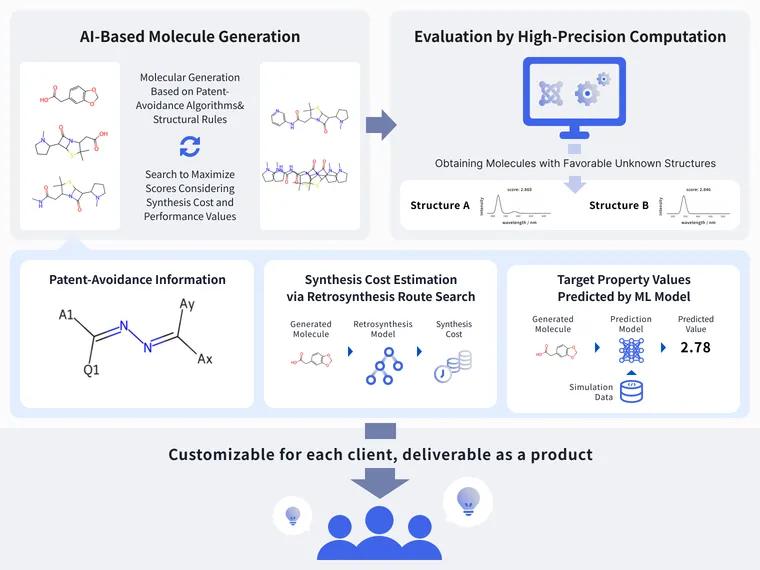
Image and Spectral Analysis
Challenge: Difficulty in quantification and identifying key factors
Many R&D fields, including semiconductors, catalysts, and nanomaterials, rely on image and spectral data. These data are often difficult to evaluate quantitatively, creating challenges for applying Materials Informatics and identifying interpretable key factors. In addition, when composition and process conditions involve multiple stages, linking these data to outcomes becomes complex. As a result, analysis has often depended heavily on researchers’ experience and intuition.
Solution: Feature extraction and application to machine learning
Using proprietary analytical know-how, MI-6 extracts numerical features from images and spectra. By converting information previously treated as qualitative or intuitive into quantitative data, we make it possible to apply machine learning to these data sources. As a result, researchers can identify key factors that were previously difficult to discuss quantitatively.


miHub
miHub is an R&D intelligence platform that connects experimental data, analysis, collaboration, and development management in one environment. By integrating researchers’ domain expertise with Materials Informatics and AI, miHub helps organisations transform data-driven R&D from individual practice into a shared capability. It captures not only data and analysis results, but also the reasoning, context, and decisions behind them, supporting better collaboration and stronger R&D management.
Formulation Optimisation for Low-Melting Glass
Challenge: Optimising formulations to meet target performance requirements
Based on past knowledge, the project explored combinations of several components selected from dozens of candidate main ingredients, aiming to overcome the trade-off between thermal conductivity and glass transition temperature. The search space contained an enormous number of possible combinations, and conventional development approaches had not led to significant improvement. Because researchers could not intuitively judge which candidates were likely to perform well, progress remained limited.
Solution: Efficient composition search using Bayesian optimisation
By applying Bayesian optimisation, miHub made it possible to predict performance across a large unexplored design space and identify high-potential candidates, including combinations that would not typically be considered through conventional approaches. With only several dozen additional trials, the team discovered compositions that achieved higher performance at lower cost than previous approaches. MI analysis using miHub® does not stop at finding optimal compositions. It also helps researchers gain valuable insights throughout the exploration process.
Organic Synthesis Process: Antisolvent Crystallisation
Challenge: Finding optimal process conditions
In monomer production for polymer materials, it was necessary to identify antisolvent crystallisation conditions that simultaneously satisfied three objectives: purity, yield, and volumetric efficiency. Because there were many variables to consider, including solvent types and ratios, exhaustive experimentation was impractical. In addition, manufacturing process design consists of multiple stages, making it necessary to shorten the time required to examine conditions at each stage.
Solution: Identifying key variables and focusing experimentation
Using a proprietary LASSO model, MI-6 analysed the process data and identified variables that should be prioritised for further investigation. The predictive model enabled comprehensive evaluation of candidate experimental conditions. By screening a vast number of possible process conditions and narrowing them down to those with higher feasibility, the team was able to objectively select promising conditions before experimental validation.
Organisation-Wide Deployment of Materials Informatics
Challenge: Sharing know-how and research knowledge
The key to advancing data-driven R&D is the integration of Materials Informatics with the data, know-how, and knowledge accumulated through years of research and development. In MI analysis, the reasoning behind the study and the analytical methods used are critical. However, complex analytical workflows are difficult to share, making it easy for knowledge to remain dependent on individual researchers.
Solution: Linking trial-and-error, interpretation, and MI analysis
miHub® enables teams to record and share data analysis together with the interpretations and discussions that emerge from it. Analysis, interpretation, and discussion can take place on a single platform. By combining MI analysis with existing know-how and research knowledge, miHub promotes R&D that can be developed and deployed as a shared foundation across the organisation.



Lab Automation

Through automated experimentation, AI-guided planning, and multimodal lab agents, MI-6 supports the transition toward autonomous R&D workflows. Our aim is not only to increase throughput, but to help researchers shift from manual execution to orchestration, enhancing creativity, judgement, and organisational productivity.
Automated and Autonomous Experimentation for Inorganic Thin Films
Challenge: Managing a large number of parameters in thin-film development
The synthesis of thin-film materials involves many process parameters, making it difficult to efficiently identify conditions that produce samples with target properties. In semiconductor-related fields, where technologies evolve rapidly, R&D teams must also increase throughput and shorten development timelines.
Solution: Automated synthesis and analysis combined with optimisation in miHub®
MI-6’s automated and autonomous experimentation system for inorganic thin films can continuously perform thin-film synthesis and analysis. The data obtained are analysed and optimised in miHub®, enabling more efficient experimentation. By taking a broader view of large volumes of high-quality data, the system also helps identify important synthesis parameters and generate new scientific insights.
Automated Dispensing and Synthesis for Liquid Materials
Challenge: Limited number of samples in parallel organic synthesis
In the synthesis of polymers from monomers, reactions often take time, and only a limited number of samples can be synthesised in parallel. This makes it difficult to increase development speed. Dispensing and mixing materials before reaction also requires considerable manual effort, placing a significant burden on researchers both in terms of time and attention.
Solution: Parallel synthesis and automated optical measurement using automated dispensing
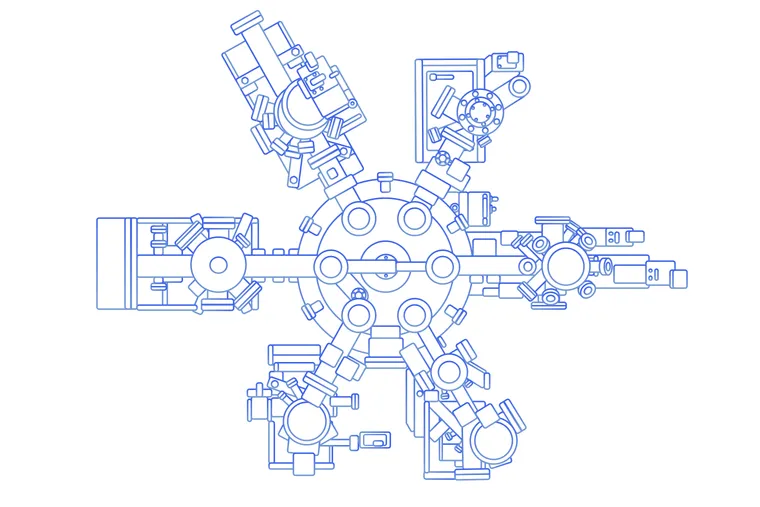
By combining an automated dispensing system for liquid materials with a heating unit, up to 48 samples can be synthesised in parallel. After synthesis, GPC measurement and optical measurement of thin-film samples can also be automated. In the future, integration with miHub® will enable autonomous closed-loop operation across synthesis, measurement, data analysis, and the next synthesis cycle.
Customer Stories
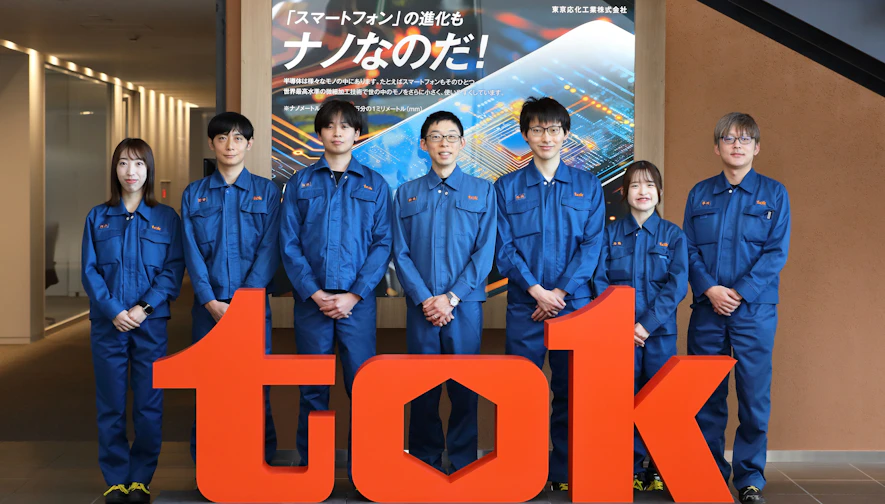
How the World’s No.1 Photoresist Maker, TOK, is Building a Data-Driven R&D Culture Through Materials Informatics
- Company
- TOKYO OHKA KOGYO CO., LTD.
- Industry
- Chemicals
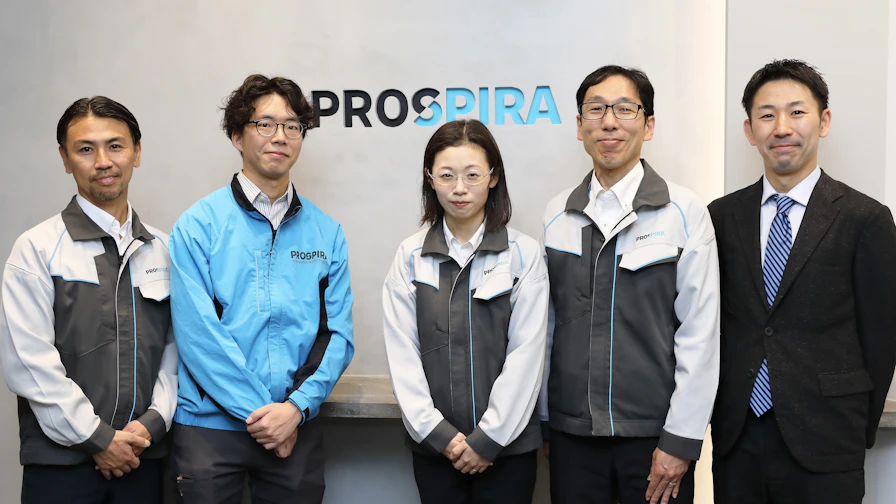
Data-Led Materials Innovation: Prospira's Drive to Become the World's Leading Vibration-Damping Rubber Developer
- Company
- Prospira Corporation
- Industry
- Chemicals
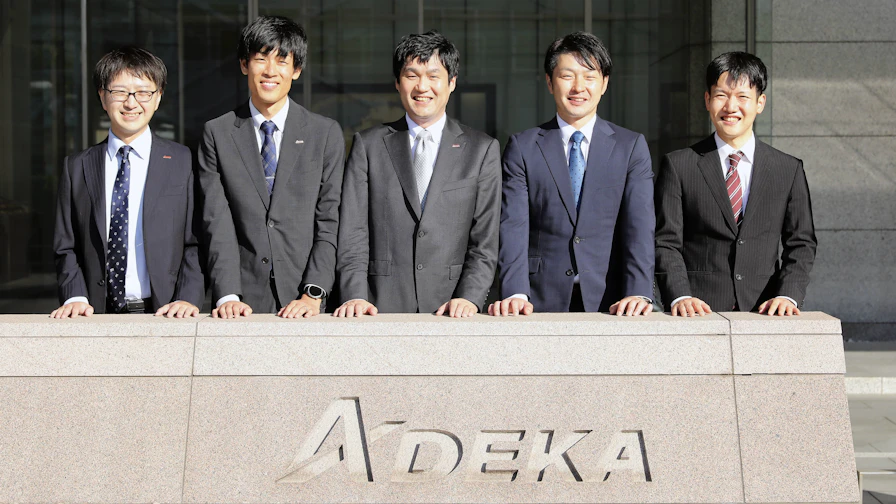
How Hands-On miHub® Training Sparked a Self-Driven Shift Toward Data-Driven R&D
- Company
- ADEKA CORPORATION
- Industry
- Chemicals