
Prospira Corporation is a global supplier of vibration-damping rubber, an essential component for smooth, comfortable driving, and brings its proprietary technology to markets around the world. With a mission to contribute to society through outstanding quality, the company has been supporting the evolution of mobility by drawing on more than 80 years of accumulated expertise.
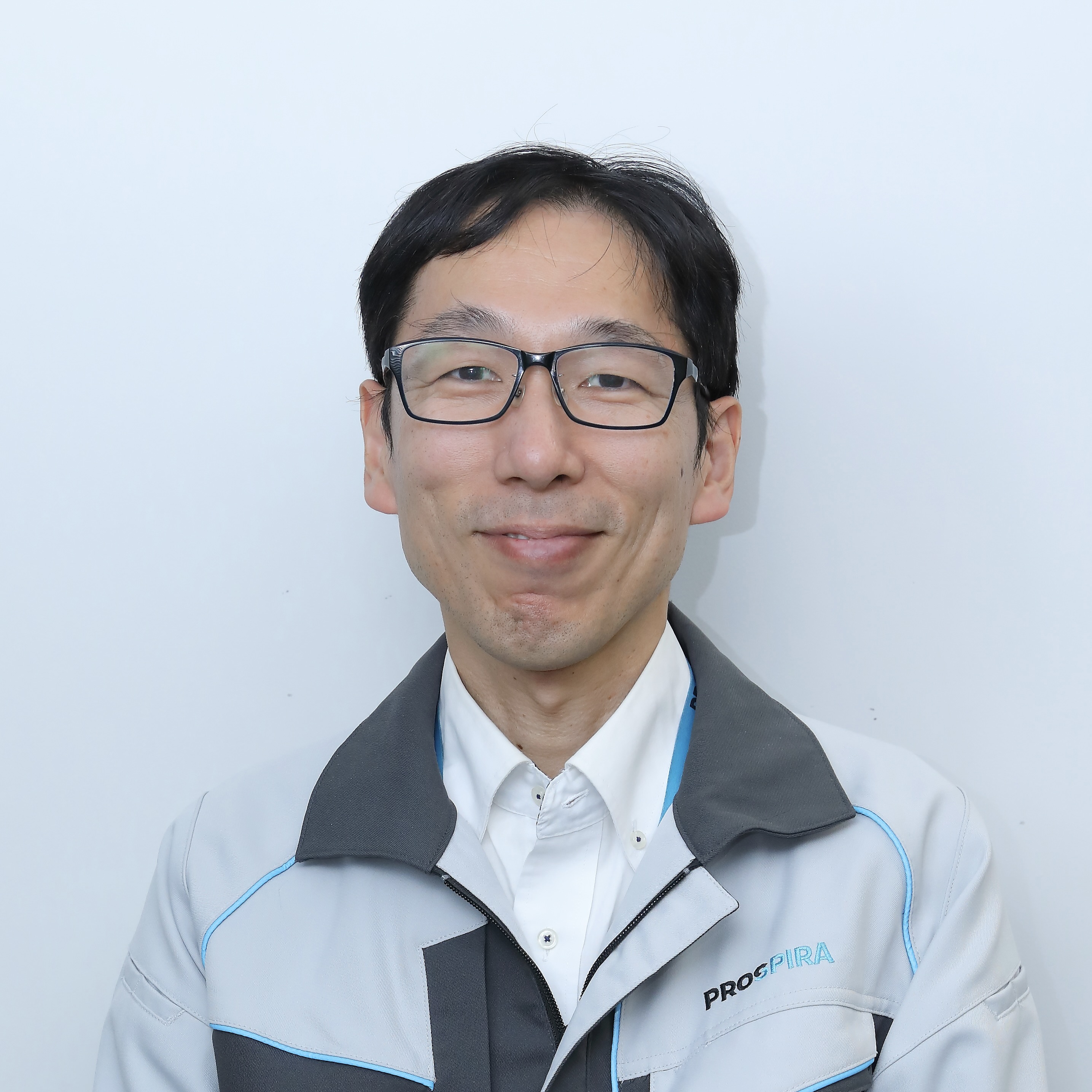
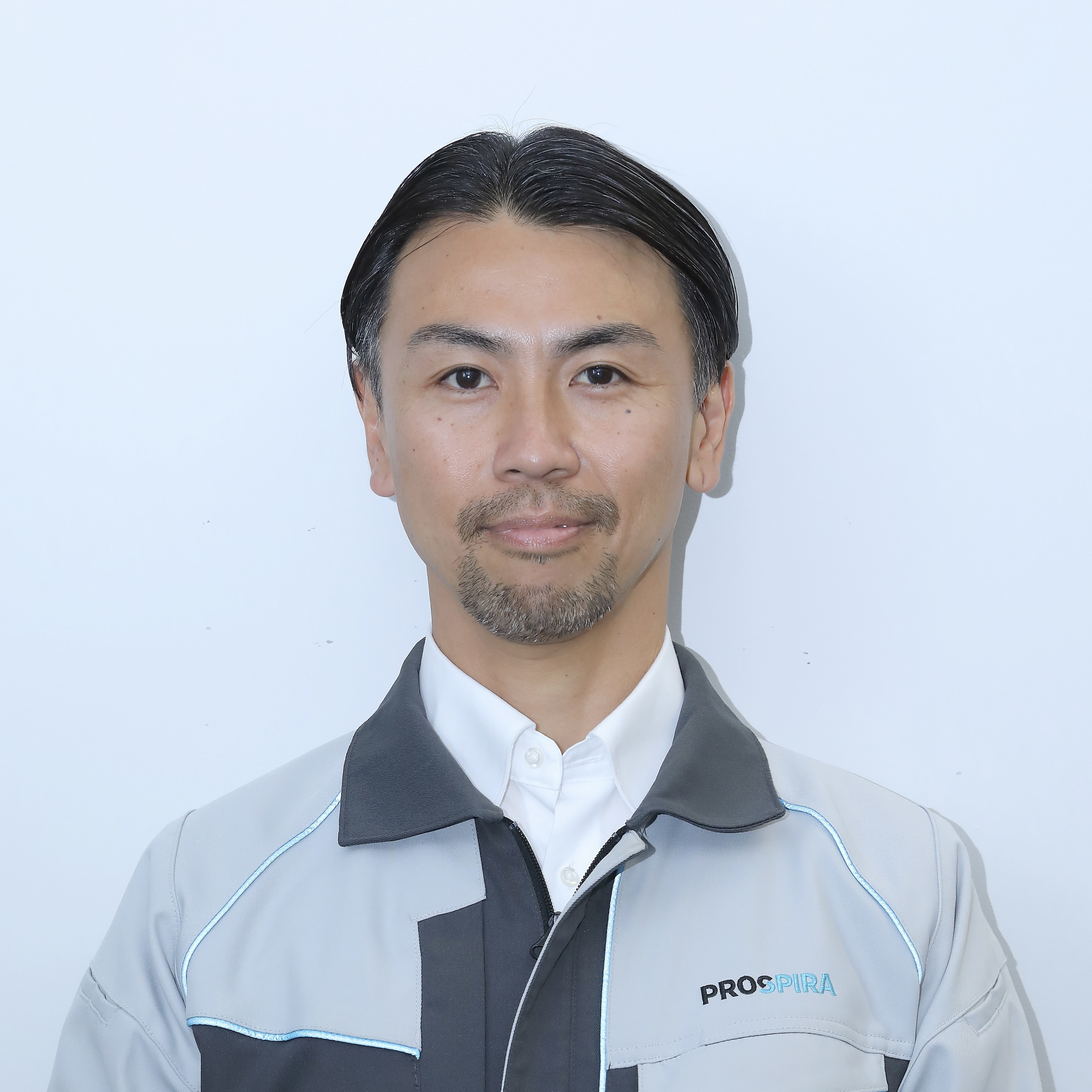
Prospira began evaluating the adoption of MI in early 2022 and went on to introduce Hands-on MI® later that year, followed by miHub® in 2024. We spoke with Akihide Osaku, General Manager of the Material Development Department; Takeshi Nagata, Section Manager of the Material Design Section; and Emiko Wada and Raito Kato of the same section, about the background and their outlook going forward.
Using new Technology to Maximise Efficiency with Limited Resources
To begin with, could you tell us about your company’s business overview and main products?
Prospira Corporation was founded through the transfer of Bridgestone’s vibration-damping rubber business and has since built its operations on world-class vibration-damping rubber technology. The company provides a wide range of products globally, primarily for automotive applications, as well as for construction machinery, marine equipment, and industrial air springs.
Our strengths lie in our solid technical capabilities and our fully integrated in-house system that covers everything from raw-material procurement to production and logistics. This allows us to maintain strict quality control, ensure stable supply, and develop products that meet each customer’s specific requirements.
Vibration-damping rubber is a critical component used in engines, motors, and suspension systems, supporting both comfort and safety through vibration control. By absorbing and reducing the large vibrations transmitted from the engine and road surface through the elasticity of the rubber, it helps deliver a smooth and comfortable ride — and that is the role Prospira plays.
Rubber compound development is often compared to cooking. Just as you think through which ingredients and seasonings will go into a dish, rubber compounds are made by blending a wide range of raw-material. Our mission is to focus on the chemical structure of those raw-materials and precisely control the compounding — which materials we choose and how we mix them — to achieve the desired properties.
The biggest hurdle is the trade-offs between properties; improving one property often leads to the deterioration of another. Finding ways to break through these opposing relationships is both the most difficult technical challenge and the most rewarding part of the job as an engineer. Achieving that is what we see as our mission.
Could you tell us about the environment around rubber materials development at the time, and the challenges you faced?

Improvements in engines and the growing adoption of EVs have dramatically increased cabin quietness. Yet the quieter the cabin becomes, the more previously unnoticed subtle sounds and vibrations emerge as perceptible noise. Achieving performance that can address vibrations in these finer ranges requires not only structural ingenuity but also the development of entirely new rubber formulations.
There were also changes within the company. After becoming independent from Bridgestone, we no longer have the vast research infrastructure we once relied on, so we must stay competitive with limited resources.
Even under such circumstances, I have kept a strong desire to become the best researcher in the world. But with conventional methods and traditional ways of working, reaching the top is not realistic. With limited resources, maximising efficiency through new technologies became essential.
From an on-site perspective as well, the inefficiency of exploring new raw-materials for rubber compounds has long been a major challenge. In the past, we mainly relied on materials introduced by specialised trading companies, but many of the proposed materials were already patented by other companies, meaning that even when their performance was excellent, we could not adopt them for commercial production.
We tried to expand our search beyond conventional rubber materials, but we soon faced another challenge: the number of potential candidates became so enormous that we no longer knew where to begin ― a real barrier to exploration.
Ideally, both tracks need to run in parallel: optimising existing materials available on the market and exploring ideal molecular structures that do not yet exist. However, it is simply impossible for any human to survey the full universe of raw-materials. We were also concerned that we might be optimising only within the narrow range we already know.
A hands-on Partner Defined by Strong Technical Expertise and Exceptional Commitment
What prompted you to adopt MI?
Back in 2022, a suggestion from a colleague got me interested in MI. My instinctive reaction was that this was genuinely interesting — if we could treat hard-to-quantify factors like chemical structure and compounding as data, we might find new answers that had never been visible before. I had long carried a strong sense of urgency that we couldn't win the next decade without embracing new technology, and MI's potential lined up with that, so we moved towards adoption.
On the technical side, we aimed to make better use of the vast volume of data we had accumulated since the Bridgestone era.
In fact, even before MI gained mainstream adoption, we had been doing data analysis with general-purpose software. It produced some results, but existing methods alone weren't enough. Against that background, we were drawn to MI's ability to use data to explore ideal chemical structures, and saw real potential in it.
What ultimately made you choose MI-6 as your partner?
We didn't have any in-house data science specialists, so we were looking for a partner who could do more than simply provide a tool — someone who could support us end-to-end, from consulting through customisation. After reviewing the major MI vendors, we narrowed the options down to MI-6 and one other company.
The decisive factor was the overwhelming passion we felt in the meeting. Every one of us came away convinced: 'These are people who will see it through with us, who will run alongside us.' With that certainty, we decided on the spot to try it for a year, and introduced in Hands-on MI®.
On the technical side, the deciding factor was that they could handle both optimisation within the existing scope and exploration into the unknown beyond it. Not only could they search within proven territory, but they could also identify promising structures by working backwards from target properties. The ability to pursue both approaches efficiently was a major part of the value for us.
Could you walk us through the process and results after introducing Hands-on MI®?
We began by applying data science to compound development for electric vehicles. During the first year of the Hands-on MI® project, MI-6 analysed our accumulated data and developed a model. Through the consulting process, we worked closely together while reviewing and refining the data as the project progressed. It was a highly collaborative process, and that approach is reflected in how we operate miHub® today.

As we began to see results during the first year of the Hands-on MI® project, we decided to apply the use of MI in other areas as well. In the second year, we shifted our focus from compound development to raw-material exploration. Until then, materials obtained through trading firms often came with little information about their additives or properties, which made it hard to pin down a scientific reason for our results. We could judge whether something worked or not, but not why — so we ended up repeating trial and error.
And as long as we relied on outside introductions, the search inevitably skewed towards rubber-related materials. With MI, we now get concrete, data-grounded candidates, and search efficiency has improved dramatically.
One of the biggest benefits has been the ability to explore areas beyond the rubber industry that would have been difficult to reach using conventional methods. We have seen first-hand that MI is far faster than relying on human experience.
As we deepened our understanding through data analysis, one clear and measurable outcome of our raw-material exploration was the identification of materials with the potential to outperform our current options. We will roll them into products at the right time, but we are confident in the results.
We use both miHub® and Hands-on MI®, but for raw-material exploration we find Hands-on MI® particularly effective. It is especially valuable when we face complex challenges, such as reaching the limits of existing materials or struggling to determine the right direction. In those situations, the expert guidance we receive through Hands-on MI® helps us identify a path forward.
Halving Development Time Paves the Way for miHub® Adoption
Could you tell us about the results with Hands-on MI® and how you came to adopt miHub®?
In the first year, we ran a head-to-head comparison on EV compound development: a veteran engineer's conventional approach versus the same task done with MI. Drawing on his experience, the engineer reached the target through about 12 iterations of trial and error. With MI, we reached the same level in roughly half the number of iterations — about six. We were impressed by the speed.
That said, outsourcing the analysis inevitably introduces lag in data exchange and feedback. We came to feel that we needed to bring this kind of predictive accuracy and speed in-house and run it ourselves.
As the project progressed, new ideas continued to emerge, such as bringing analysis in-house through miHub® and applying Hands-on MI® to raw-material exploration from a different perspective. It felt very much like learning through experience while gradually expanding the ways we could use MI.
So we decided to introduce miHub®, which is easy to use without deep data science expertise. Starting in the second year, Kato took the lead as we moved into full-scale operation.
As an engineer, what was your impression of MI as a method?
Honestly, the term MI wasn't very familiar to me at first. My initial impression was that it was essentially data science with a stronger focus on materials.
But once we actually started using it, I saw that bringing in a mathematical perspective — quantifying chemical structures and linking them to properties — could dramatically accelerate development. We tend to think by stacking up chemical and physical theory, but I realised that using mathematical models to identify pathways to a target outcome is just as valid.
At the same time, understanding why AI produced a particular result is both the engineer's role and one of our key strengths. Even when we do not achieve the desired outcome, the process of asking 'why did the AI suggest this structure?' will lead to new insight.
Did the miHub® rollout go smoothly? Tell us about any difficulties and how you worked through them.
I had only just joined the company, so I had limited knowledge of MI — and little specialist knowledge of vibration-damping rubber. I was essentially feeling my way forward. At times, I wondered whether it might be more than I could handle. However, the MI-6 team encouraged me, and I decided to learn by doing. Concretely, I committed to using miHub® as an everyday work tool, much like Excel.
Through my work with MI, I was able to build my knowledge of vibration-damping rubber while gaining hands-on experience at the same time. As I repeated the cycle of prediction and experimentation, I gradually developed an intuition for compound design—understanding which materials to adjust in order to influence specific parameters. As my capabilities grew, the impact of the results became increasingly visible to those around me. I was surprised to realise just how significant those achievements were, and at the same time I came to appreciate once again how powerful miHub® had been in making them possible.

Experienced engineers naturally draw on their accumulated knowledge when making decisions. However, there is also a risk of becoming too focused on optimising within familiar territory. That's exactly why I wanted a younger engineer with a fresh perspective to take the lead. At the same time, the process of testing AI-suggested formulations and understanding how they relate to material properties is also one of the best ways to learn the fundamentals of these materials.
The intuition that veteran engineers develop through years of trial and error, Kato was able to acquire in a remarkably short time through repeated cycles of prediction and experimentation with MI. I have been working in this field for 20 years, while he has been with the company for less than two, yet we are able to engage in technical discussions as equals. That fact alone speaks volumes about the educational value of MI. That alone speaks volumes about the educational impact of MI.
Have you seen that effect spread to other team members as well?
Yes, definitely. Following Kato's success, other team members have also stepped forward to take part. Kato shares what he has learned with them, they fill each other's gaps as they go, and that has created a healthy dynamic in which they challenge and support one another.
The key to expanding its use was getting people genuinely engaged with it. No matter how effective a tool may be, it will never become part of everyday work unless users are personally committed to it. That is why we chose to place it in the hands of team members who were motivated to explore its potential. Thanks to these efforts, we have moved beyond simply proving its effectiveness and have entered the stage where MI is being used in day-to-day operations. Our next challenge is to expand that adoption both within and beyond the department.
Bringing in MI has also changed how we look at data. Rather than pursuing a narrow, point-by-point search as we did in the past, we are beginning to develop the habit of looking at data from a broader perspective and considering how it can be used with MI. I am convinced it is this shift in thinking that will lift our development capability over the long term.

Strengthening Technical Capability with MI Toward Becoming the World's Leading Vibration-Damping Rubber Manufacturer
How would you rate MI-6's support?
MI-6's data scientists are able to explain even complex technical concepts in a way that is easy to understand, enabling us to resolve questions quickly and move forward with confidence.
The practical support has also been highly attentive. For example, when we were struggling to define the target variable, they proposed methods we would never have come up with ourselves. Through detailed reviews of the data and short follow-up meetings after each submission, they helped ensure alignment and prevent misunderstandings, allowing the project to progress very smoothly.
It feels like a genuine partnership. Rather than simply delivering analysis results, MI-6 helps us deepen our own knowledge and capabilities. Going forward, I want to deepen my own understanding to the point where I can make suggestions of my own.
The MI-6 team has deep expertise in data science. Even when all we have is a broad idea of what we want to achieve, they help us clarify the requirements and develop data-backed recommendations. What I particularly appreciate is how deeply they engage with our challenges, supporting us even in areas we would normally be expected to work through ourselves. That support has been quite reassuring.
It is precisely because that trust is so strong that we can move forward with confidence, knowing that we can rely on their support whenever needed.
Finally, could you share your goals and outlook going forward?
My near-term goal in raw-material exploration is to find new material options that expand our formulation possibilities and reduce our dependence on a small number of key materials.
I would like to see more colleagues using miHub® internally. When formulation development is carried out individually, perspectives can easily become fixed. However, through discussions with team members, I have experienced how much our perspectives can broaden.
Even in areas where the right answer is unknown, data gives us a common language for discussion. We can exchange ideas, understand each other's thinking, and have constructive conversations. I find that process incredibly creative and enjoyable, and I hope to help foster a culture where people enjoy data-driven dialogue.
We are also planning to take our use of MI to the next level. At present, we run exploration (Hands-on MI®) and optimisation (miHub®) separately, but we want to link them seamlessly. By running a cycle where the analysis results on each side feed back into the other, we should be able to accelerate R&D further.
I would like to see MI become a standard tool in the formulation development process. It is effective not just for grand research themes but also for solving urgent issues under tight deadlines. The ability to quickly build models from existing data and gain insights that point toward a solution is exactly what helps strengthen our responsiveness to customers.
My ideal is a culture in which team members naturally think of MI first whenever they encounter a challenge, rather than relying on top-down instruction. To be honest, the people using the tool on a daily basis understand its finer details better than I do. However, the knowledge they accumulate becomes an asset for the company, and there is no need for me to understand every detail myself.
I would like to continue placing my trust in both MI-6 and the team members leading these efforts, and keep entrusting them with projects going forward.
Looking ahead, our ambition is to become the global leader in vibration-damping rubber development. To achieve this, we aim to push the accuracy of predicting physical properties from polymer structure to the highest possible level and establish a clear technological lead in this field.
If we can successfully integrate that capability into our rubber development process, we believe we can truly become the world's leading vibration-damping rubber manufacturer. MI will play a critical role in strengthening our long-term technical competitiveness, and we look forward to continuing to work with MI-6 as a trusted partner in achieving that vision.
Product structure and shape can be copied, but the rubber itself, as a material, cannot. Rubber is, in the end, 'a black lump' — a black box whose contents are invisible from the outside. That is exactly why we want to keep refining the technology behind it and stay a step or two ahead of the competition.
Thank you very much to the team at Prospira Corporation for generously sharing their time and insights.
*Note: The content of this interview is current as of November 18, 2025.
You can download more details about Hands-on MI®, our professional analysis service, for free from the link below.
Click here to request information on Hands-on MI®
You can download more details about miHub®, our SaaS-based Design of Experiments (DoE) platform, for free from the link below.
Click here to request information on miHub®
For any other inquiries regarding Materials Informatics (MI), please feel free to contact us at the email address below.
Business Development Department, MI-6 Ltd. bd@mi-6.co.jp