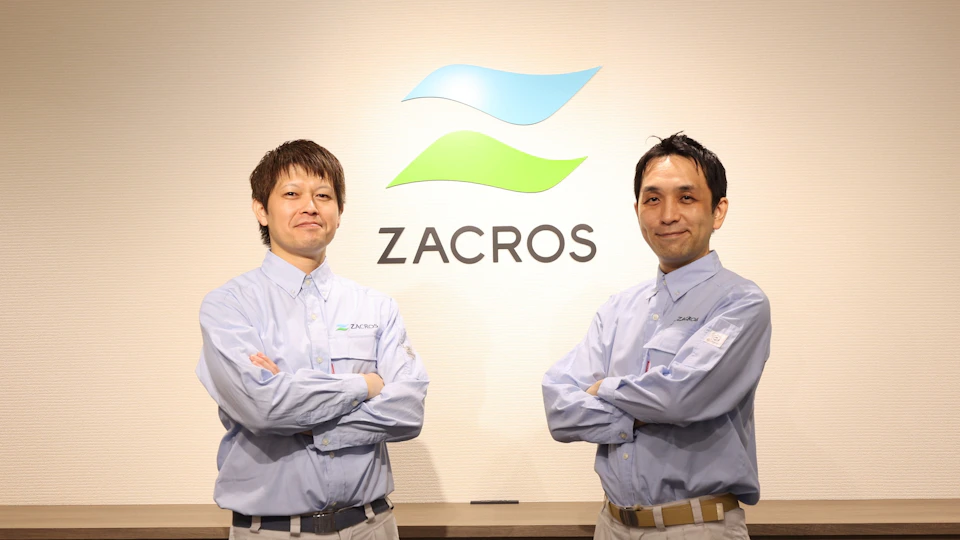
Founded in 1914, ZACROS Corporation has spent more than a century building on its core expertise in packaging, guided by a philosophy of supporting people and society through the spirit of "wrapping." The company now delivers a broad portfolio of products and services across wellness, environmental solutions, information and electronics, and industrial infrastructure — working to build a future the next generation can be proud of.
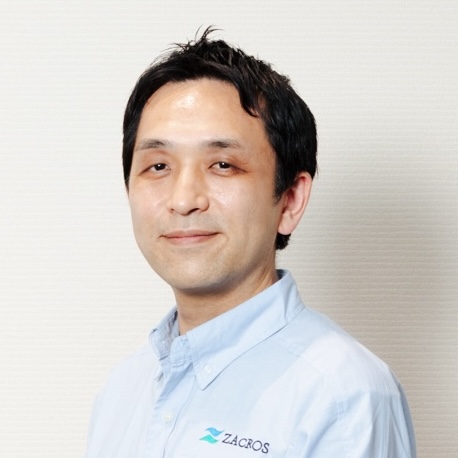
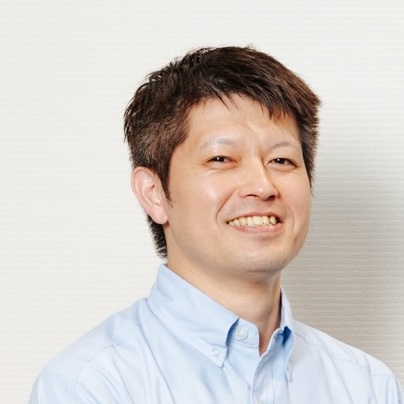
At the company's central R&D site — the laboratory responsible for advancing core technologies and developing new products — the team began evaluating Materials Informatics (MI) in 2021 and adopted miHub® that same year. We spoke with Shinichiro Suzuki of the Planning and Promotion Group, Research Promotion Department, and Takashi Tsukada of the Adhesives Technology Development Group, Core Technology Development Department, about how this came about and where they see it going next.
Tackling a Wide Range of Fields Is One of Our Strengths
Could you tell us what the Planning and Promotion Group is mainly responsible for?
We drive DX across the laboratory as a whole. It's been about three years since we started focusing on it seriously. DX is gathering momentum not just here but across the chemical industry, and I think a big reason is a shift in social values. We've come from a mass-consumption era, but going forward it isn't enough to simply produce at scale — we need to be environmentally conscious and make the right things efficiently. The flow is also moving towards anticipating customer needs and delivering solutions alongside the product. That push for precise, efficient manufacturing, combined with the rapid evolution of digital technology, is what's accelerating DX in our industry.
To stay ahead of the market and bring out products aligned with where the world is heading, you need strong R&D capability — and the people doing that work are stretched thin. Running a research theme involves the experiments themselves, plus the prep beforehand and the write-ups afterward. There are patents to draft and administrative tasks too. On top of that, some R&D staff handle customer interactions directly when technical discussions are needed, so they often end up short on hours for the bench work itself.
We run a lot of product development in parallel and at speed, so capacity does get tight. At the same time, our mandate is to get products to market ahead of competitors.
With finite resources, we still take on a wide range of themes so that we can explore broadly and seed future programmes. While we're in that "planting many seeds" phase, the load on R&D inevitably gets heavy — but we recognise that the willingness to take on a variety of fields is itself one of our strengths as a company.
Plastic films are our main product line — packaging for consumer goods, medical packaging, plastics for electronic components and so on — but we don't only extend what we already sell. We're also pursuing what next-generation plastics should look like. Being nimble in launching new R&D and getting outputs back out the door is a real strength of the R&D function.
We have a long history of customising to what customers ask for, and that responsiveness is something we take pride in. As Suzuki mentioned, researchers themselves dealing directly with customers is both a distinctive feature and a strength. How quickly we respond shapes the impression we leave, so development speed is something we take seriously.
Seeking Software Strong in Formulation Work with Bayesian Optimisation
Could you tell us what led you to adopt miHub®?
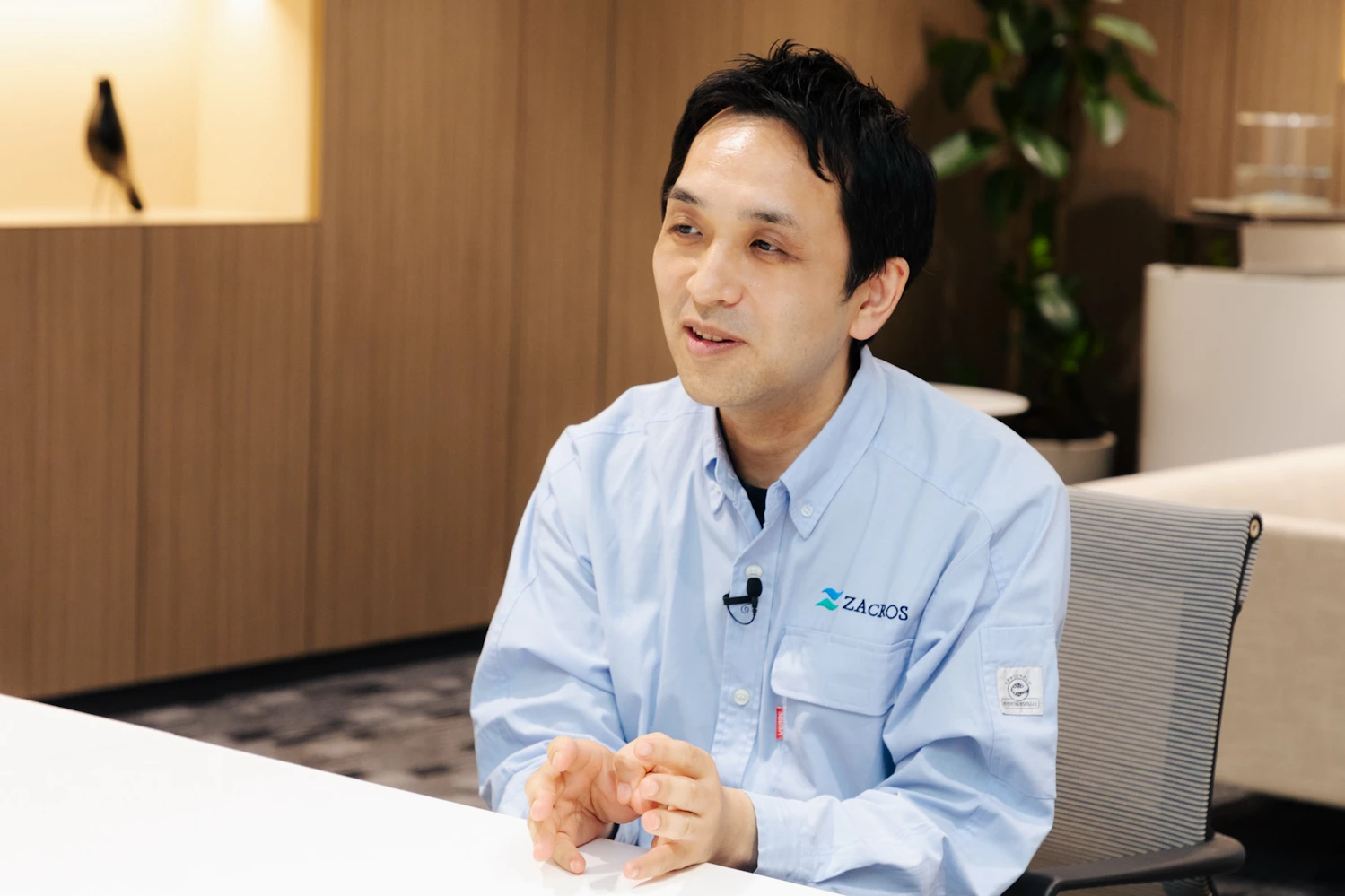
Over the past few years, "MI" has been appearing more often in trade publications, and vendors have been bringing different services to market. We had been keeping an eye on it, and with backing from senior management we started seriously evaluating an MI rollout. As I mentioned, because we plant a lot of seeds for future themes, we need to properly organise the accumulated knowledge from that process and hand it on to the next generation — so MI was also seen as a way to consolidate research know-how. Acting on that direction from management, we sat down with several MI software providers and began comparing them.
Walk us through how you got to selecting miHub®.
I put together a comparison table covering what each tool could be used for, the algorithms, ease of use, pricing and so on, and we worked through it internally. Once we'd narrowed it down to a handful of vendors, we moved on to a more detailed evaluation.
We're mostly a plastics-processing company, and the bulk of what we do involves polymer properties and formulation work rather than molecular design — so our first filter was software that fits that style, strong on formulation work. There turned out to be more tools focused on molecular design and molecular-orbital calculations than I'd expected.
At the pre-adoption research stage we were complete novices in MI, so we interviewed experts and companies that had already adopted it. What came out of those conversations was that, among the various algorithms available, Bayesian Optimisation was especially well suited to formulation work and tended to deliver results more readily than other MI techniques. So we added "capable of Bayesian Optimisation" to our criteria. Once we also required a track record with polymers, the field narrowed to about three vendors.
After working through those three in more depth, we decided that what mattered most was something the researchers themselves would find easy to use, and we chose MI-6's MI tool, miHub®. We don't want our R&D people doing programming-type work — we want them using MI to make experiments more efficient — so a clean interface and good usability were priorities. When we're not sure whether our experiments fit miHub®, or when we want to try something a bit more advanced, we lean on the data scientists in MI-6 Customer Success who support us.
People often say MI has a high barrier to entry, but I see that as an interface problem. Search for MI and you'll get screens full of Python code — and given how much programming-language text that throws at you, it's no surprise some people have an allergic reaction. If the interface were as simple as, say, the Google search page, that barrier would drop. miHub® comes close to that. The deeper knowledge, I think, is something you can pick up afterwards.
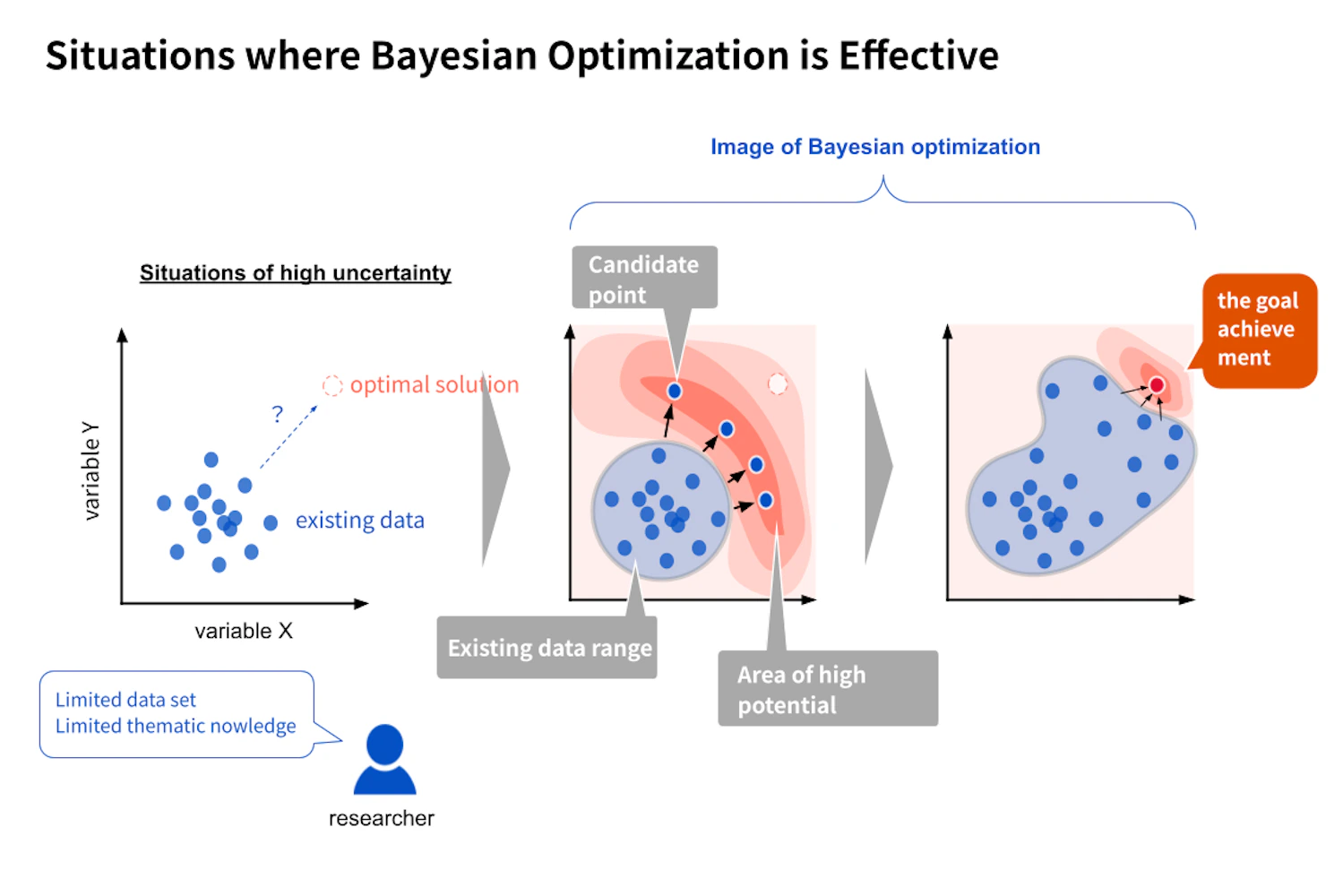
Bayesian Optimisation's strength: efficiently covering the experimental space while balancing exploitation (making the most of existing data) and exploration (trying new formulations and materials)
How We Got from Selection to Live Operation
Walk us through what happened between choosing miHub® and putting it into live use.
We started by making Tsukada here our first user. Our thinking was that for the trial, it made sense to approach someone reasonably junior, flexible and proactive. Compared with people who've been at the lab for a long time, younger staff are generally more willing to say "sure, let's give it a go."
Tsukada's theme had an established experimental routine and a reasonable backlog of data. He's strong at experimental work, proactive, and quick on his feet, so expectations going in were high. And in those early MI evaluations he ran experiments at quite a pace — he had the tough job of "producing a clear early win," and he delivered exactly that, the kind of pioneer result that's easy to point to. It gave us a story we could readily make the case with internally.
That said, MI suits some types of experiments and research better than others, so even with Tsukada's success there were people who said, "I can't just apply that as-is." Even so, after hearing him present his results, others started thinking "maybe I should try it too," and when we followed up a while later some came back saying they wanted to give it a go themselves. We share past experiments openly, so when people dig into those, I think it nudges them towards trying it out.
How did it feel being named as the first user?
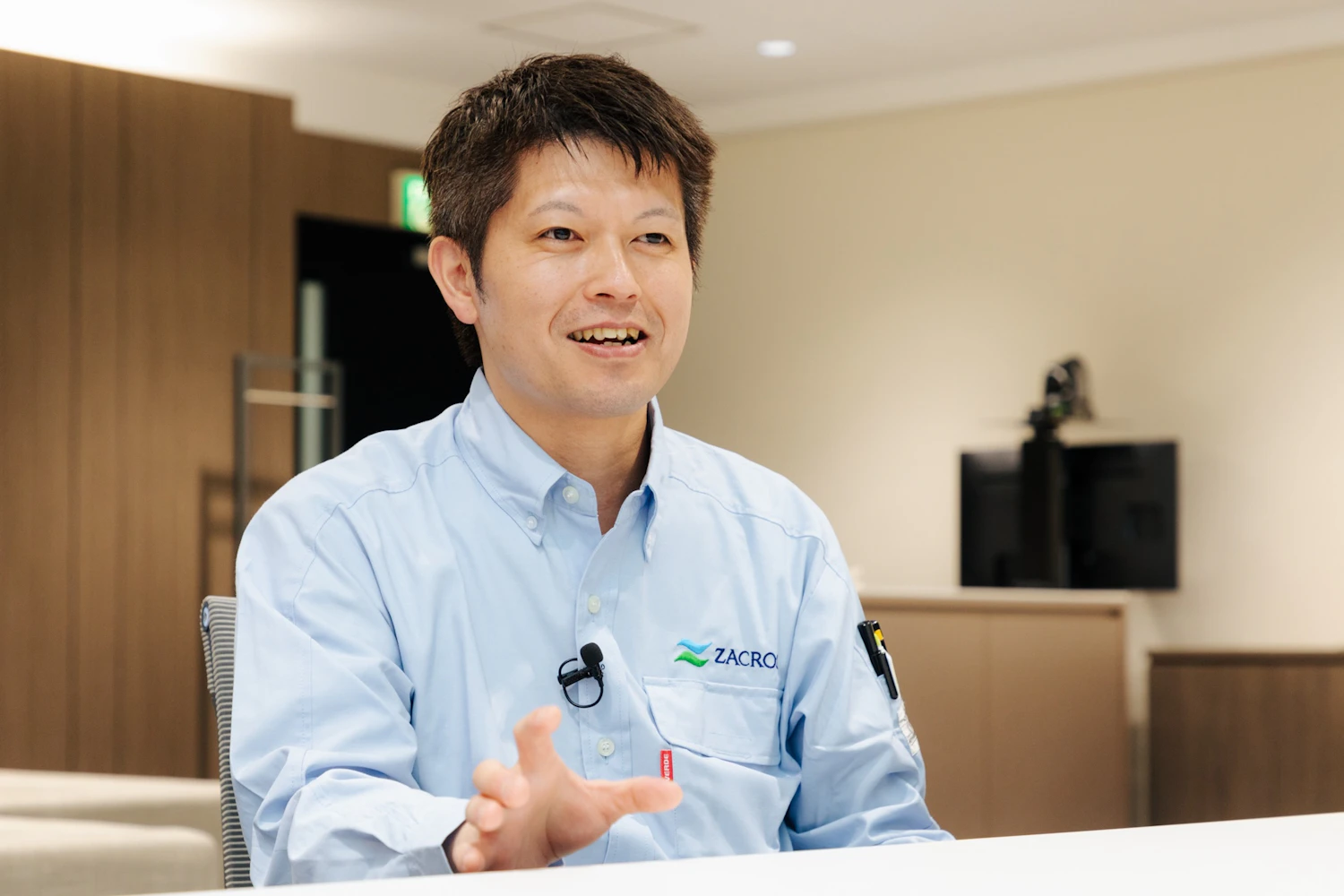
I'd been hearing about it since the evaluation stage, but at first I was thinking "what even is MI?" — my understanding was basically "apparently this is something good to use." When I was asked to run the trial, my honest reaction was that it sounded like a lot of effort. But once I actually started using it, miHub® would suggest conditions I'd never have thought of myself, and I began to find that genuinely interesting.
Once I felt I was getting somewhere with MI, Suzuki asked me to help spread it across the company, and I was happy to take that on. Personally, I liked the idea of having more colleagues using miHub® — more people sharing tips, more momentum behind making the tool better to work with. Just suggesting "why not try it?" to people around me lifts efficiency for the group and the lab, and it opens up a conversation with that person too.
That played out exactly as we'd hoped. Tsukada passed on the finer points of using the tool to people around him, and on that front too he's contributed a lot to getting miHub® adopted.
A Trial Built Around the Researcher
Many companies start their trials with the highest-impact projects. We hear you took the opposite approach — putting the researcher first and picking a theme owned by someone with strong motivation to try MI. What was the thinking behind that?
Some researchers want to try MI; others would rather not. If we asked someone to apply MI to a theme by saying "this is a high-profile project, so please run it," we'd risk creating negative feelings — other people thinking "I was keener and I didn't get picked," or the person tapped feeling pressured because they don't really want to do MI but have to because it's a key project. Which themes really matter, which ones MI fits, whether results actually come out — these are things you can't fully know without trying. And AI tools like MI also depend on how well they click with the individual. So we've taken the approach of starting with projects whose researchers are genuinely motivated to use MI.
What matters at first is that people who put their hand up get to use MI on their own theme and become comfortable with it. The theme they start with doesn't have to be one of the company's top priorities. Once you've used MI once, that becomes personal experience, and you can judge whether it fits your next theme. Once you've seen what MI can do, you naturally start thinking about using it on more important projects. So our priority is to grow the number of people who know MI and who have touched it. The cost-benefit may not pencil out at the very beginning, but we believe a world is coming, within a few years, where you can't win without MI — where using MI is just the default. Part of what we're doing now is laying the groundwork for that.
What effects have you seen since adopting miHub®?
The most striking thing is how much faster we're moving. In the trial we specifically evaluated how much miHub® sped things up, and the numbers backed that up. I also came away convinced it shortens the overall investigation period.
It depends on the project, but in some cases experimental efficiency has improved by 1.5 to 2 times. Beyond speed, miHub® occasionally surfaces experimental conditions we'd never have spotted on our own. For example, it'll recommend a formulation along the lines of "mix these materials at this ratio" — something a human just wouldn't come up with — and sometimes those actually deliver good results. Speeding up experiments was our original goal and that alone is hugely valuable, but the fact that miHub® sometimes turns up conditions only MI could find is another real benefit.
Beyond shortening individual experiments, adopting miHub® has started getting some of our R&D members into the habit of recording experimental data in a format MI can ingest. That data includes failed experiments, and because MI uses those failures as well when proposing the next recommended condition, we're starting to do R&D that genuinely puts negative results to work.
The support from the MI-6 Customer Success team has been a real help as we've put MI to work. In project meetings they advise us from the perspective of someone running chemistry experiments — on things like temperature settings or charge ratios in the formulation process — and it really feels like we're running the project side by side. Honestly, the support we get from our contact there matters more to us than the system itself. There are things we can't crack with internal capability alone, and we work through them with MI-6; going forward we want to keep using their support as a driver of our progress.
Toward a Lab Where MI Is as Everyday as Excel
How are you planning to use miHub® going forward?
Our goals are to grow the user base and to grow the number of successes and concrete examples. Early on, no one really knew what MI was or whether it could apply to their own theme, so it didn't spread easily within the lab. To get the number of people who at least know about MI moving up, we set up a dedicated MI page on the intranet. Any researcher can access it easily, and we keep it stocked with content that makes it straightforward to pick up the basics. We also run internal MI seminars on a regular cadence, where past project results are shared and MI-6 walks us through miHub®. To grow the pool of people who really understand MI, we make use of our meetings with MI-6: anyone interested in MI is welcome to sit in on the project meetings, and we now have a growing number of people who "know MI even though they haven't used it yet."
There are also people who don't join those meetings but still want to try miHub®, so anyone who wants to can simply contact the programme team and start using it. We try to keep the threshold as low as possible, and where someone wants to take it further, we encourage them to dive in. When real examples come out of that, we have them present at the internal MI seminars so the results reach as many people as possible. The head of the lab has been backing the seminars, and standout successes are eligible for formal recognition. With that kind of support around us, I think we've managed to build a "let's all do MI" atmosphere.
Could you share any concrete goals you've set?
We haven't fixed a strict headcount target for users, but the long-term slogan we've set is "a lab where MI is as everyday as Excel." Ideally, in five years everyone has at least touched it, and in ten the slogan is a reality. Usage rates and awareness numbers will fall out of that naturally. I don't think this is far-fetched at all. Excel didn't exist a few decades ago either, and today almost everyone in a business setting can use it. Maybe people thirty years ago thought "using Excel? That's absurd" too.
Thank you very much to the team at ZACROS Corporation for generously sharing their time and insights.
*Note: The content of this interview is current as of May 15, 2024.
You can download more details about miHub®, our SaaS-based Design of Experiments (DoE) platform, for free from the link below.
Click here to request information on miHub®
For any other inquiries regarding Materials Informatics (MI), please feel free to contact us at the email address below.
Business Development Department, MI-6 Ltd. bd@mi-6.co.jp