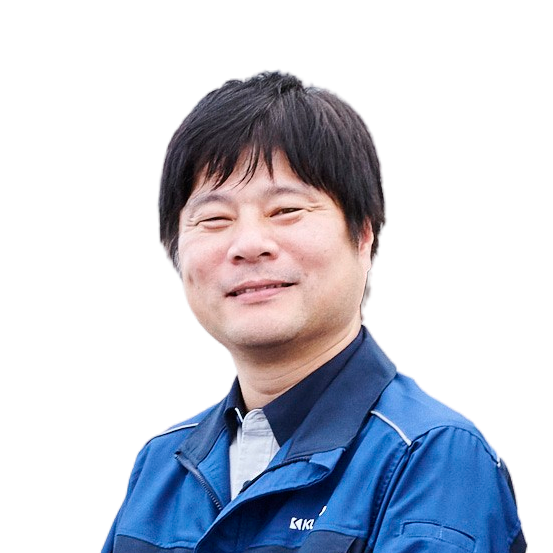

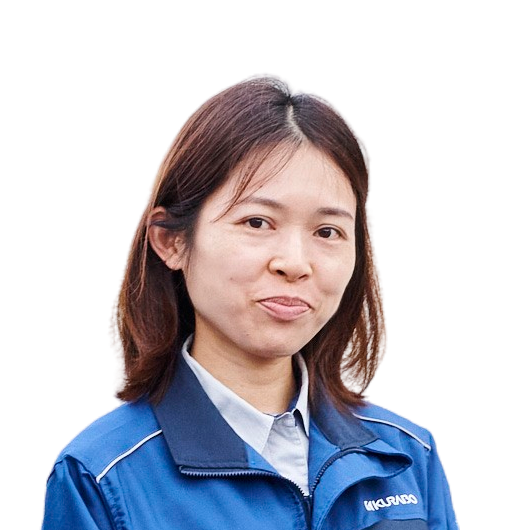
Founded in 1888 as Kurashiki Spinning Works, Kurabo Industries Ltd. has built more than 130 years of history. Alongside its founding textile business, the company operates across a broad portfolio that includes chemical products, environmental and mechatronics technologies, and food and services, supporting everyday life and industry alike.
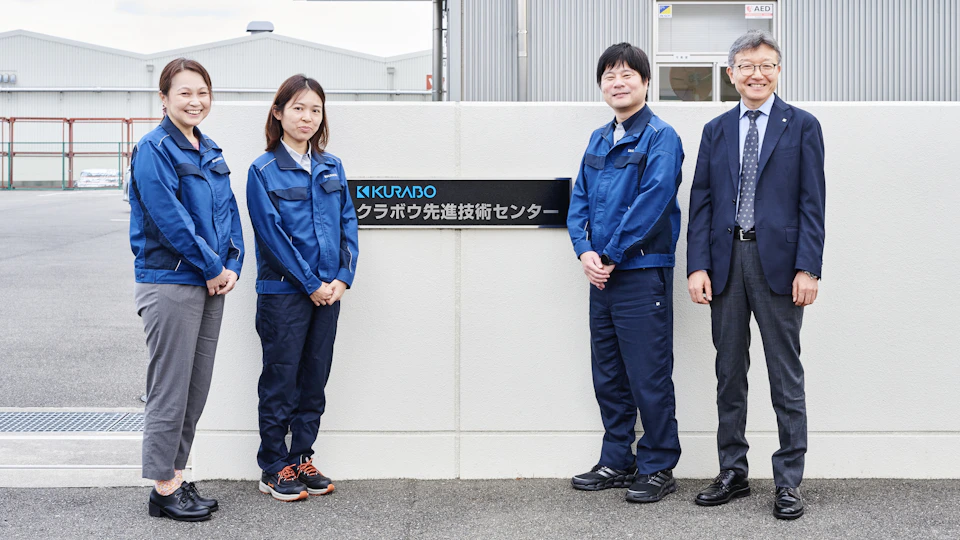
The Core Technology Group at Kurabo's Technical Research Laboratory, which leads the company's R&D, began considering Materials Informatics (MI) around 2013 and adopted Hands-on MI® in 2020. We spoke with Katsuma Yagi, who drove the initiative as Manager of the Technical Research Laboratory at the time, together with Eiichiro Haginoya, Yuko Nanjo, and Chinatsu Miyazaki of the Core Technology Group, about the background and where they plan to take the work next.
Supporting New Business Development by Establishing Reliable Core Technologies
To start, could you give us an overview of the Core Technology Group at the Technical Research Laboratory?
The Technical Research Laboratory has two roles: 'research', where we identify new technologies through investigation and exploration, and 'development', where we create new products and materials. Our focus areas have shifted over time, but since around the 1960s we have been continuously supporting and developing new businesses for Kurabo.
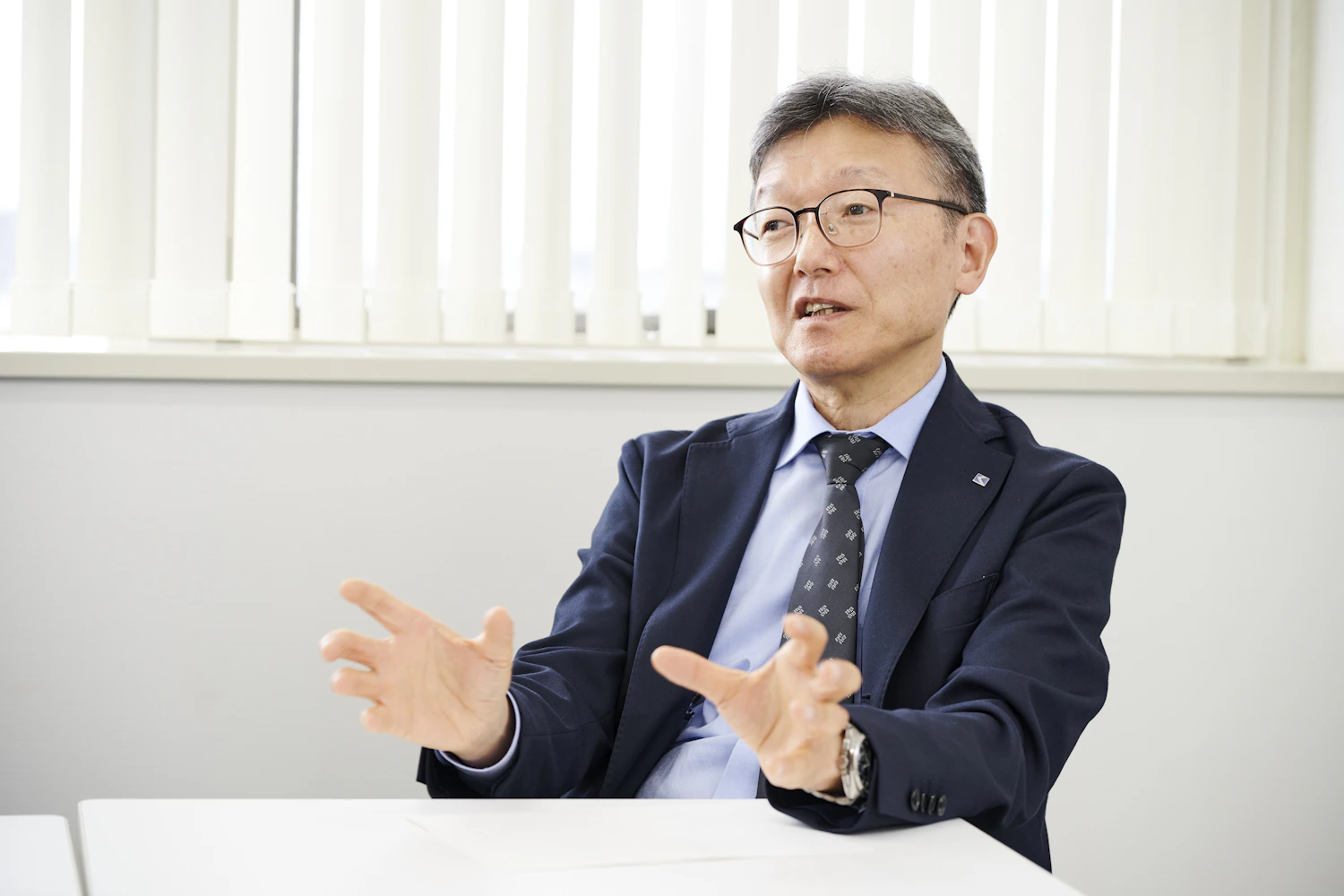
Since I took over as Manager in 2013, we have been restructuring the organisation to become a 'new kind of research institute' that contributes to growing Kurabo's business. The Core Technology Group was set up as part of that reform.
The group is made up of six teams working on technology validation, including Materials Science, which handles plastics and fibre-related materials development; Mathematical Science, which covers numerical analysis and thermo-fluid simulation; and Physical Science, which deals with equipment design and motion control. The aim is to establish the core technologies that underpin new business launches and to differentiate Kurabo by combining the new technologies found in each field.
Taking on a 'New' Approach to Technology Exploration with Information and Computational Science
What led you to consider adopting MI?
It started with our plan, as part of the mission to transform into a 'new research institute', to launch a technology exploration effort that drew on information science and computational science methods. While we were thinking through how to approach it, a business consultant I had known for years told me about 'an interesting company' — that was MI-6.
I expected that MI, grounded in probability and statistical methods, could be useful for materials development. The fact that we had team members who I felt would flexibly take on something completely new also gave me confidence, and I decided we should give it a try.
We placed the project in the hands of Miyazaki, who works on fibre-related materials development in the Materials Science team, and Nanjo, who works with data day-to-day in the Mathematical Science team.
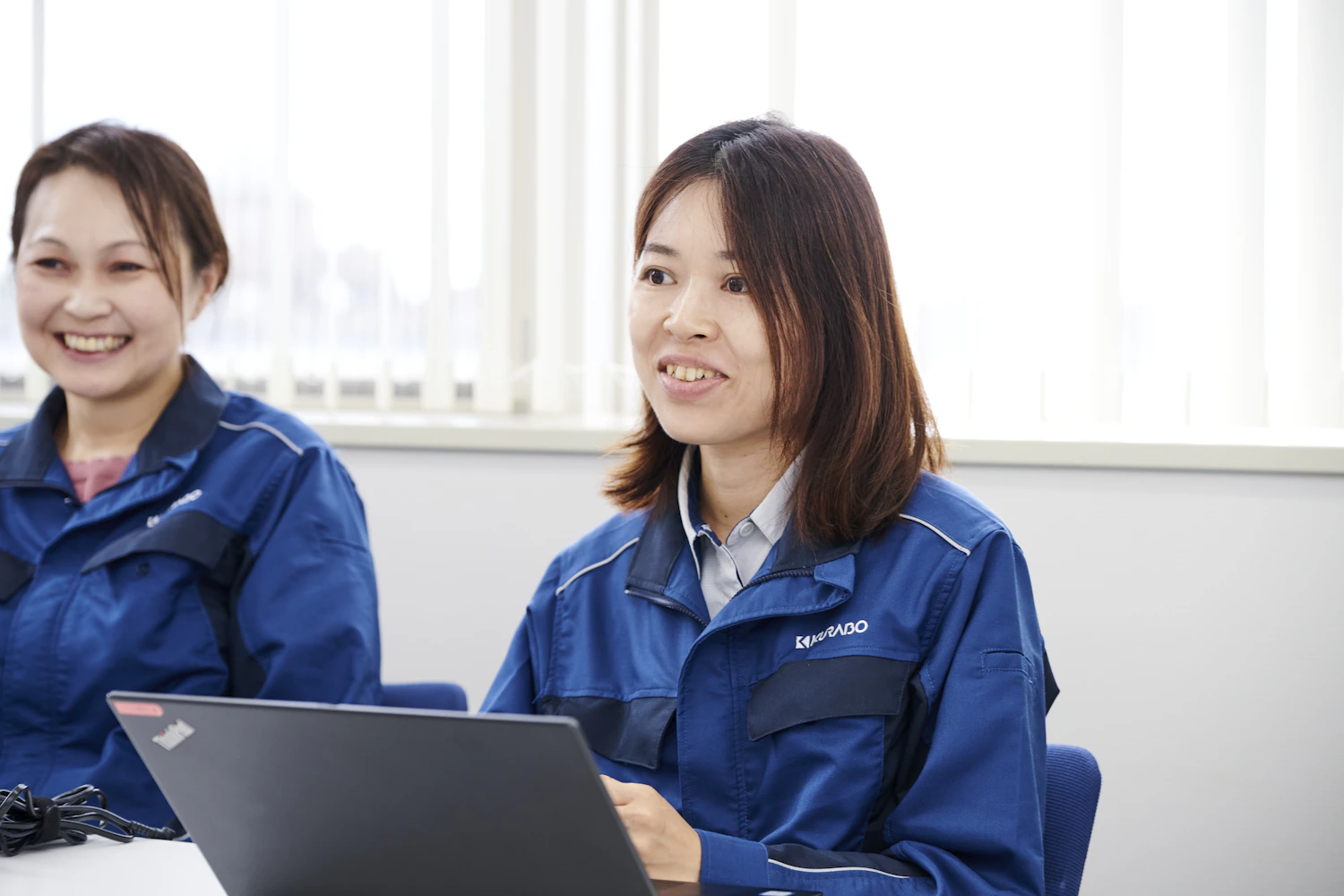
I had heard at conferences about cases where MI had shortened development timelines, and I felt it was a capability we needed in-house — and one that could become a competitive threat if other companies adopted it first. That's why I joined the project.
I studied physics and have always been comfortable with data and computation, so I joined hoping to help with building programs, preprocessing data, and running analyses. The Materials Science team runs a lot of experiments every day, and I wanted to put that data to proper use.
Why did you choose Hands-on MI®, where a data scientist works alongside you?
The deciding factor was that they support MI-driven R&D from the ground up — from technical consulting through to developing in-house data scientists and helping us manage the MI rollout.
We felt that going beyond standard technical support and working in close, hands-on communication would be the most effective way for us to learn MI and use it properly.
Moving Beyond Intuition: Experiments That 'Think and Speak in Data'
Can you walk us through what you actually did after adopting Hands-on MI®?
We started by showing the MI-6 team the data from bio- and fibre-related projects we were working on at the time. With their advice, we sharpened our picture of what kinds of data make MI applicable and what results we could reasonably expect, then moved on to applying MI to actual projects.
Were there any challenges during the adoption process?
We had assumed there was plenty of usable data inside the company, but once we actually opened things up, a lot of it turned out to be unreliable or had significant gaps. Cleaning that data up was one of the most time-consuming parts of the project.
With three parties in the conversation — the in-house MI leads, the bench researchers, and the MI-6 team — I imagine the biggest hurdle was 'language': how each side could get their thinking across to the others.
Exactly. I started with zero background in MI or data analysis — I didn't know what a 'machine learning model' was, or in what form I needed to provide data so that a 'model' could be built. So we'd ask for an analysis, look at the results, and then work out 'how we should have presented it'. It really felt like we were tuning our shared vocabulary by trial and error.
For me, the difficulty was communicating with the bench researchers. I would go and watch experiments in person and ask question after question — 'What is this?' 'Why are you doing it this way?' 'Why do you stop here?' — gradually building an understanding of how they thought and where the variability in results was coming from.
I came back to the Technical Research Laboratory a little after Hands-on MI® had already been adopted, and I was struck by how different the MI way of thinking was from the mindset I remembered from my earlier years in development.
When interpreting test results, instead of relying purely on the researcher's experience and intuition, we were now asking 'can we really say that?' and trying to reason from the data. At first I had real trouble catching up with this. Through repeated conversations, understanding gradually grew, and over time the mindset of the experimentalists — myself included — shifted bit by bit.
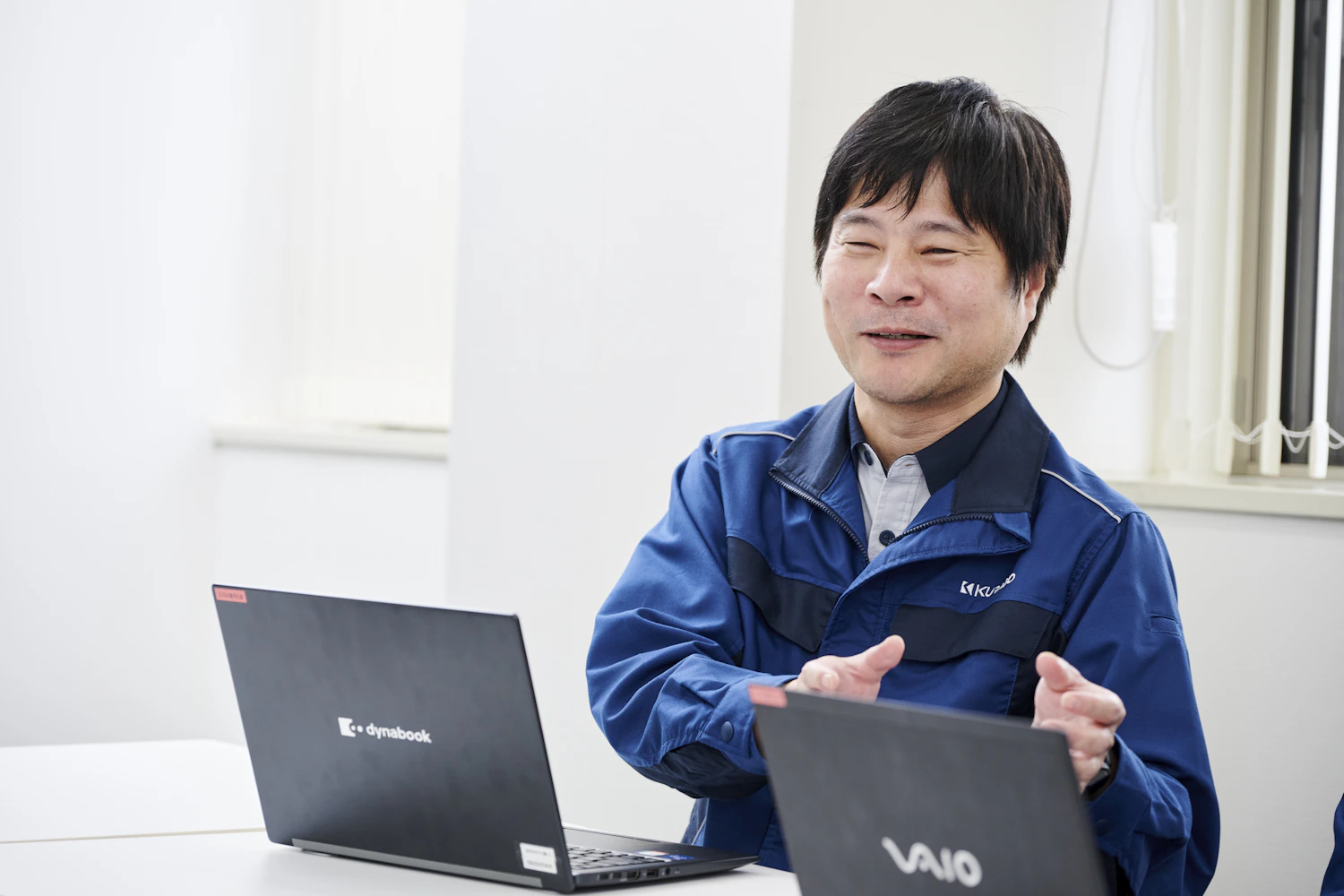
What kept you going through those challenges?
'Let's do something interesting' is part of Kurabo's culture, so there's a genuine willingness to take on something new and unfamiliar.
The goal was never adopting MI for its own sake — it was doing better R&D. So we approached it with the attitude of figuring out whether MI fits and helps our R&D, and whether we could actually master it ourselves.
I was always conscious of lifting the value of the data we already had inside the company and turning it into data we could actually use.
Seeing the Team Grow Through MI-6's Hands-On Support
What outcomes or internal changes have you felt from adopting Hands-on MI®?
The bench researchers' attitude toward data has changed. The habits of 'collecting data properly and analysing it properly' and 'predicting what comes next from quantitative data rather than rules of thumb and intuition' — that whole way of 'thinking and speaking in data' — is starting to take hold.
Compared with before, more people are doing things on their own initiative too — like looking at the same graph from several different angles.
And on top of that, people are now going to Nanjo with things like 'I ran these numbers — can you spot any trend?' or 'If I collected the data this way, could we get something out of it?' We're not yet at the point where we can do the calculations ourselves, and of course not everything turns into a result — but the very fact that 'let's go and ask' has become the first instinct is striking.
I suspect the researchers themselves, even while having to turn experiments around quickly to meet a wide range of business requests, had also been quietly wondering whether endlessly repeating one-off experiments that don't lead anywhere was really good enough.
Against that backdrop, being able to produce — with MI-6's support — concrete examples of what data can do gave people the sense that 'this kind of data, used this way, lets us run this kind of analysis' and 'we can actually get this far with Kurabo's own data'. I think that built the momentum to take on MI together.
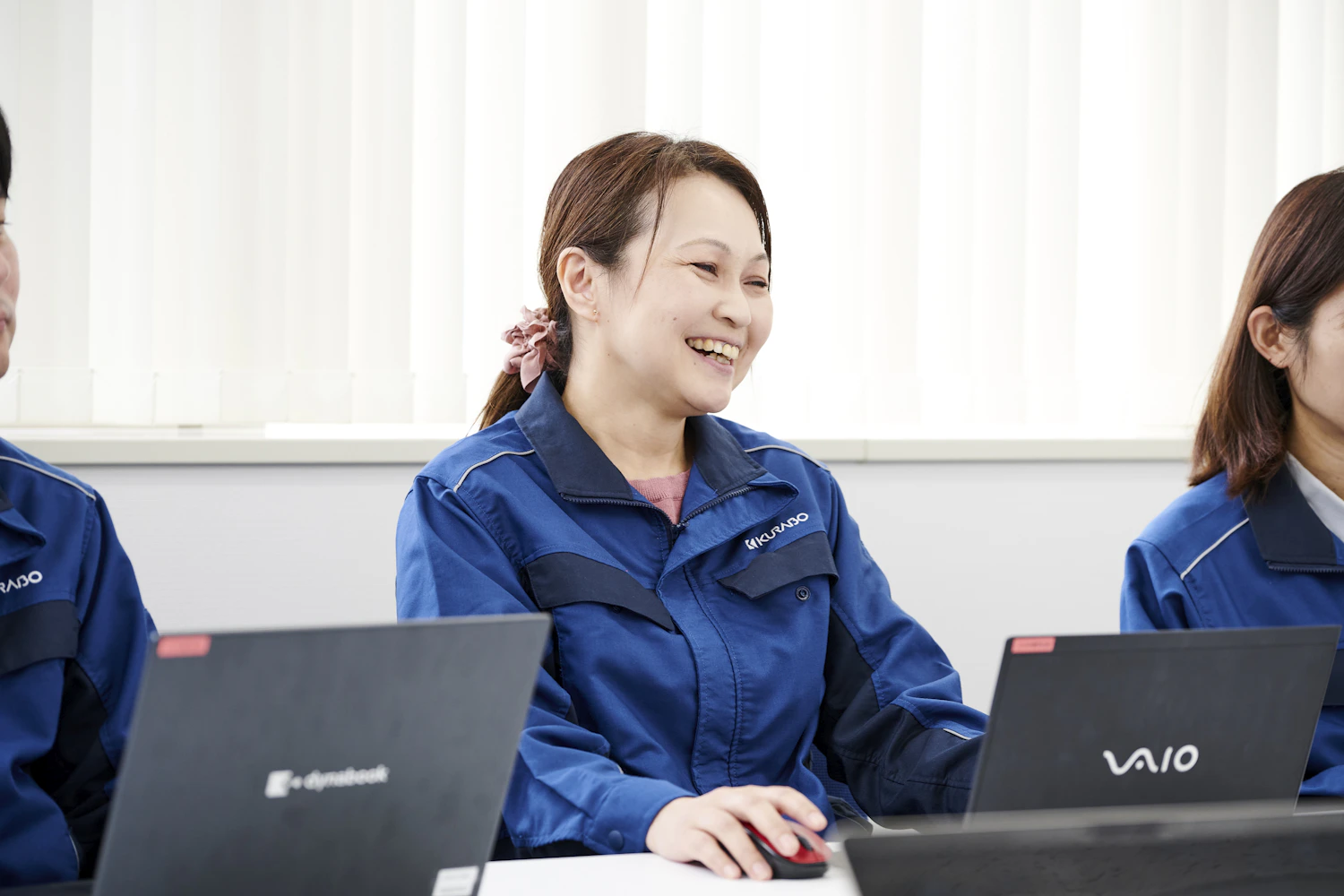
How would you evaluate MI-6's support throughout the project?
Coming in with no informatics background and no clear picture of what an analysis of our own data would even look like, picking up MI on our own and rolling out the tooling would have been extremely difficult. Being able to talk directly to MI specialists right at the start of our journey from zero was a real boost to getting MI in place efficiently.
On top of pitching the technical support at the right level for us, they also advised us on how to organise ourselves for a successful rollout — for example, how to position MI leads relative to bench researchers. That was genuinely valuable.
Once it became clear that our data was unreliable, they gave us a lot of advice on how to make the case internally for changing the way we run experiments and how we accumulate data. They also taught us a range of preprocessing techniques and ways of looking at data, and I'm grateful that we are now able to do analyses with smaller datasets.
As each of them has just described, the team's mindset and skills have come up, the group's capability has grown, and the research culture has shifted significantly. None of that could have been achieved simply by 'teaching MI methodology'. As the person responsible for the institute, I am genuinely grateful to MI-6 for advising us on applying MI across the wide range of topics we work on, and for helping us prove that it can be useful in our research.
Of course, not every project ended in success, but the team will have learned a great deal in the attempts. Given how hard it is to grow people, the fact that our members have developed this much makes Hands-on MI® a very effective investment in my view.
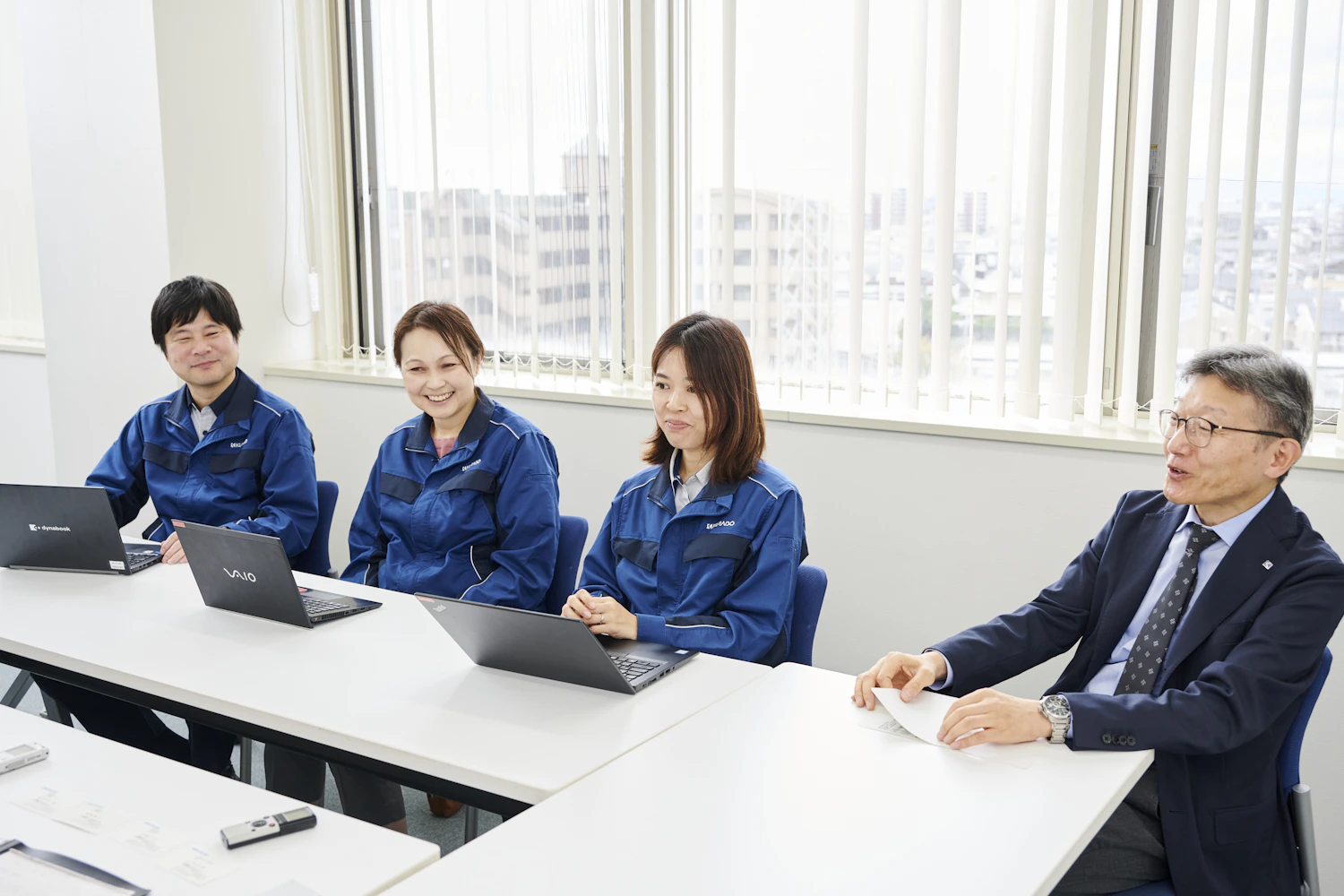
Identifying Where MI Pays Off and Using It as One Tool Among Many
Finally, could you share your outlook going forward and what you would like from MI-6?
Over the course of the project, we've moved away from quick one-off experiments toward collecting data comprehensively, understanding the trends and variability, and using that to drive the experiment cycle — there's been real progress in 'consciously collecting more data'. Going forward, we want to take the next step and focus on running experiments more efficiently, including pushing ahead with the predictive models that Nanjo is currently leading.
Through working with MI-6, we're seeing far more quantitative thinking and quantitative results in place of pure intuition, and I'd like to build on that shift to do more data-driven analysis. From the MI-6 team, I'd love to learn more general-purpose data handling techniques over time.
We don't actually use MI all that often at this point, but I want to keep it ready as one tool in the kit, available whenever we need it. Through this project we've become reasonably good at judging whether a given topic is one where MI will pay off, so going forward I want to make sure we don't miss the right moments to use it.
MI as a technology will surely keep evolving, and I'd be glad if MI-6 could continue to share, on an ongoing basis, any technical developments that look useful for Kurabo.
Beyond that, it would be valuable if you could share the kind of information and perspectives we couldn't pick up on our own — where the technology sits in the broader landscape, how trends are shifting, what other companies are doing. We hope to continue the kind of relationship where two companies can really have a 'dialogue'. We look forward to working with you going forward.
Thank you very much to the team at Kurabo Industries Ltd. for generously sharing their time and insights.
*Note: The content of this interview is current as of October 28, 2024.
For any other inquiries regarding Materials Informatics (MI), please feel free to contact us at the email address below.
Business Development Department, MI-6 Ltd. bd@mi-6.co.jp