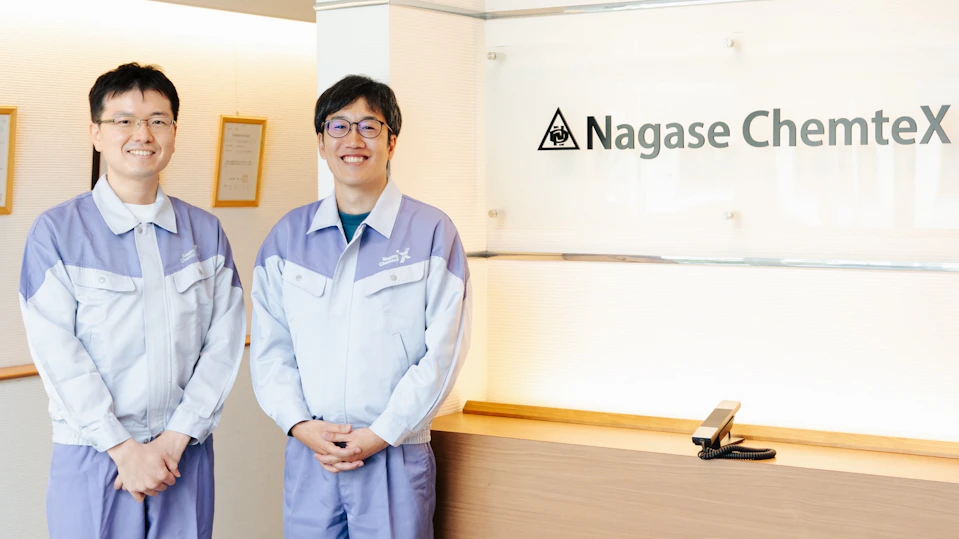


Founded in 2001 as the core chemicals manufacturer within the NAGASE Group, Nagase ChemteX Corporation develops and manufactures a wide range of chemical products under the slogan "We will create a brighter future through chemistry" supporting customers' growth across many industries.
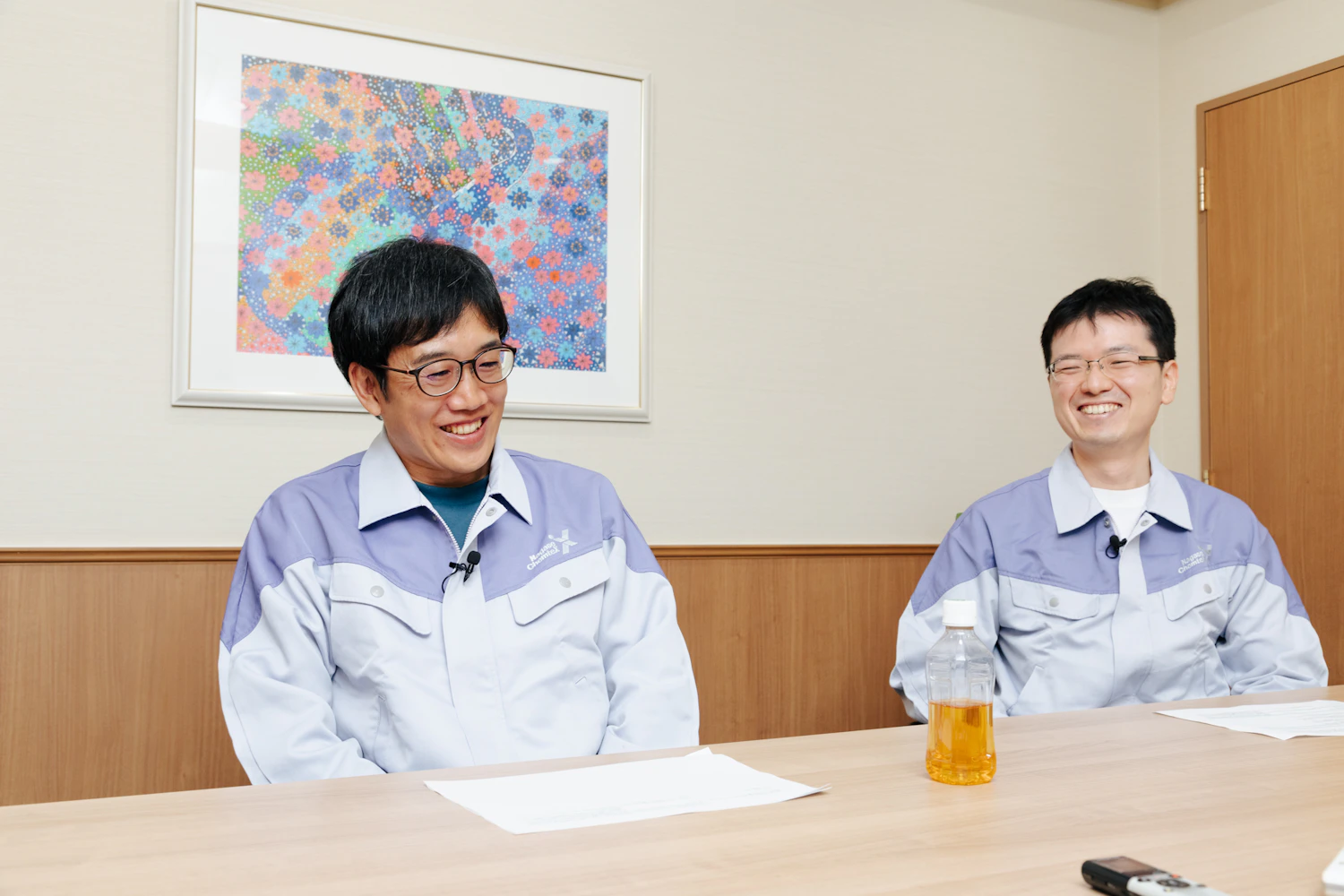
The company's Product Development Division within the Functional Chemicals Department began evaluating Materials Informatics (MI) in September 2021 and adopted Hands-on MI® in November 2021. We spoke with Masato Fushiki and Takahiro Sakurai, who led the MI rollout in the department at the time, about the background and their outlook for the future.
An R&D Organisation Developing High-Performance Materials for Diverse Markets
To start, could you give us an overview of your business and an introduction to the Product Development Division within the Functional Chemicals Department?
Nagase ChemteX is a chemicals manufacturer that develops and produces a broad range of chemical products.
One of our core businesses, the Functional Chemicals business, develops and manufactures high-performance materials built on organic synthesis, polymerisation, and formulation technologies, supplying markets that include automotive, displays, and hygiene products.
Within that business, the Product Development Division is responsible for new product development. Sakurai and I have worked mainly on coatings, customising performance and properties to meet customer requirements and developing materials that strengthen our underlying technology.
Hoping to Unlock Fresh Ideas by Putting Our Accumulated Data to Work with MI
Could you tell us about the background to adopting MI and the situation at the time?
We have done R&D in the Product Development Division for many years, but as competition in the industry intensifies year on year, we felt we weren't delivering significant leaps in performance, and we weren't making full use of the data accumulated from past development projects and experiments.
As we looked for ways to address these issues and accelerate the development of better materials, we came across MI as an option. With many use cases already emerging, we had a general sense from the outset that adopting MI might let us develop materials with performance our conventional thinking couldn't reach.
What led you to consider adopting Hands-on MI® specifically?
I had been interested in MI for some time but hadn't been able to take the plunge. What got things moving was learning about MI-6 and its services through my manager, and then gathering the whole section to watch MI-6's webinar, "Three Steps to Embedding MI in Your Organisation in 90 Days." Rather than focusing on the technical side, it focused on how to drive MI adoption inside an organisation, and what stuck with me was how thoroughly it covered the points where teams typically get stuck.
Seeing nothing but MI success stories had left us wondering, "What's it actually like in practice?" and "Even if it's a powerful tool, can a team like ours, with no know-how, really make it work?" The webinar put those worries to rest.
The hopes we had built up for MI while gathering information, together with the fear that competitors might pull ahead by wielding MI as a weapon, hardened after that seminar into the conviction that we had to adopt MI.
Why did you choose Hands-on MI®, where a data scientist works alongside you?
With limited MI experience in-house, we knew from the start that we would need to draw on outside expertise to move a project forward. The deciding factor was that, with hands-on support, we could pursue product development using MI in a practical way, generate a success story that would spark wider adoption inside the company, and build up our own MI know-how along the way.
What appealed to us about MI-6 was its well-structured support team, which includes people with a background in chemistry. They also clearly understood the points to watch when driving MI adoption, and offered support aimed not just at getting started but at making MI stick — which gave us the confidence to let them work alongside us.
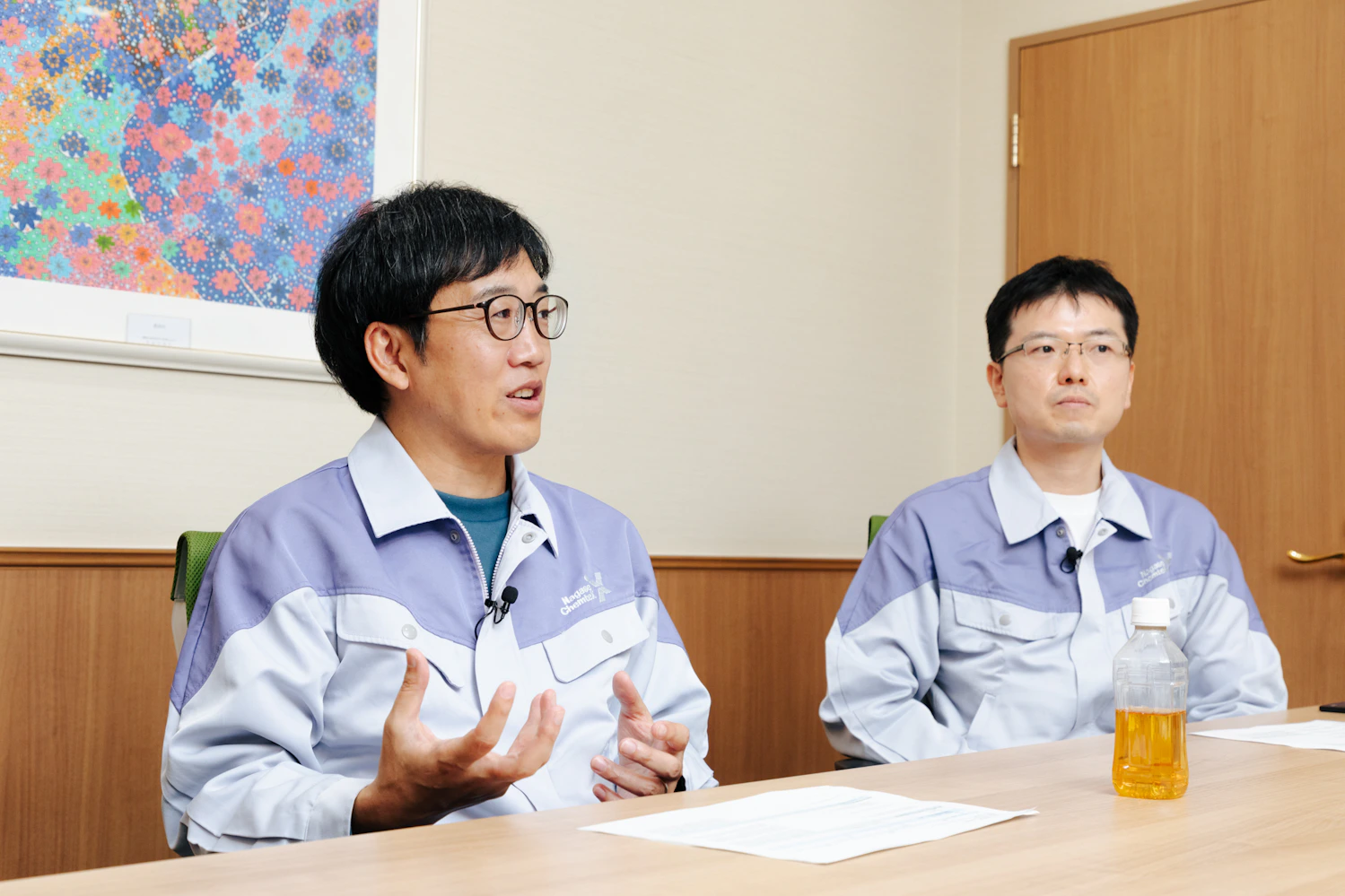
"With Experts Who Know Both MI and Chemistry Alongside Us, We Reached the Best Answer"
How did you go about the work after adopting Hands-on MI®?
I assigned Sakurai because he was the kind of person who would approach a new initiative with an open mind, even without any guarantee of results, and we built the project around him.
We brought several development themes to the MI-6 team — ones where finding a better material would meaningfully improve the product — and, with their advice on which was best suited to MI, picked one to take forward.
The theme we took on was the search for an additive that would give a coating solution a particular function — an area where we had run many experiments over the years without yet getting good results. If we had simply installed a tool, we might well have stalled at this stage, unsure what to do next. With Hands-on MI®, MI-6 organised the data and helped us judge which data we could actually use, and we worked through feature setup in discussion together.
We repeated a cycle in which our bench researchers — who know the theme and the materials inside out — and MI-6's experts, with their deep MI knowledge, talked through the data preparation and feature setup, then ran experiments based on the resulting model output and recommendations.
Could you tell us about the results from adopting Hands-on MI® and any changes you've noticed inside the company?
We found three additives that outperformed the one previously regarded as the best. Getting three strong results in just six months on a theme we had worked on for around ten years without success is, in our view, a very significant achievement.
We are now filing patents so we can apply these experimental results to new products, and it feels like a major step forward for the future.
Reporting these results led to us running an internal online seminar as well. Colleagues started coming to us saying things like "I'd love to talk through an MI question" or "What's MI actually like?" — a sign that the impact of the work was spreading.
How would you rate MI-6's support during the project?
MI-6 has many people with a deep understanding of both data science and chemistry, and they were genuinely dependable. As someone who was interested in MI but uneasy about taking it on alone in-house, I found their support reassuring.
A number of vendors offer MI technology itself, but MI-6 went further — they shared the know-how for how R&D staff should approach MI and work with the analysts to actually get results.
By talking things through with MI-6 and feeding the expertise we hold as developers into the MI work, we kept producing one good result after another. It really showed me that neither the MI specialists nor the developers alone can do it — it works when you combine the two sides' expertise.
Dividing roles clearly and talking often with each other is what got us to the best answer, I think.
Trying to do all of this entirely in-house would take a huge amount of time to learn, and people could easily give up before they got a feel for how interesting and powerful MI can be. For a first MI rollout, I really do think you need expert support to start.
We also wanted as many colleagues as possible to hear about the results and get interested in MI, so we had MI-6 run an internal webinar and present a case study featuring our results. We're very grateful for their help with our internal awareness efforts.
Making MI a Routine Option in Materials Development
Finally, could you share your outlook for the future and what you'd like from MI-6 going forward?
With society and technology changing so quickly, MI itself will keep evolving, and eventually we'll probably reach a point where everyone uses MI and AI as a matter of course. To keep up with that and remain a chemicals manufacturer customers choose, we want to get our people equipped to use MI and related technologies as early as we can.
In materials development, it's clear that customers will demand not only better performance but also even shorter development cycles than before. With that in mind, having a broad set of approaches to draw on — and making MI a routine option within that set — is going to be essential.
MI may still feel like something "special" to us, but we need to get ready for it to be recognised as a familiar, everyday tool in our work. Identifying clearly which themes MI is suited to, and sharing success stories like this one so that each person naturally thinks, "What if we tried MI here?" — that, I think, is the first step.
This time we spent six months on a single theme, but we still have many development themes ahead of us, so we want to think carefully about how to use MI to bring them to a successful outcome.
And we hope MI-6 will continue to offer the same broad support — going beyond simply providing tools and services to include consulting and sharing information.
Their support really is thorough, so to anyone considering MI, I'd say: don't hesitate to talk to MI-6 and give it a go with their help.
Thank you very much to the team at Nagase ChemteX Corporation for generously sharing their time and insights.
*Note: The content of this interview is current as of October 25, 2024.
You can download more details about miHub®, our SaaS-based Design of Experiments (DoE) platform, for free from the link below.
Click here to request information on miHub®
For any other inquiries regarding Materials Informatics (MI), please feel free to contact us at the email address below.
Business Development Department, MI-6 Ltd. bd@mi-6.co.jp